Do you have trouble with posture at mealtimes?
When caring for a family member, have you ever felt:
- Their body leans to one side while eating.
- Their feet are dangling.
- Is it really okay to eat in this posture?
Have you noticed things like this?
In fact, how easy it is to eat depends not only on the food but also greatly on the surroundings that support the body.
First, it's important to set up a posture in which the person can eat safely.
Why posture at mealtimes matters
① It lets them eat safely
If posture slumps during meals, food can more easily enter the airway, which may lead to "aspiration".
Correcting posture is an important point for continuing to eat with peace of mind.
② It makes eating easier
Eating uses not just the mouth but the whole body, including the neck, back and stomach.
If the body is unsteady, swallowing can become harder too, so first set up a posture in which the body is stable.
③ Food tastes good
When posture is stable, it's easier to focus on the meal and enjoy mealtimes.
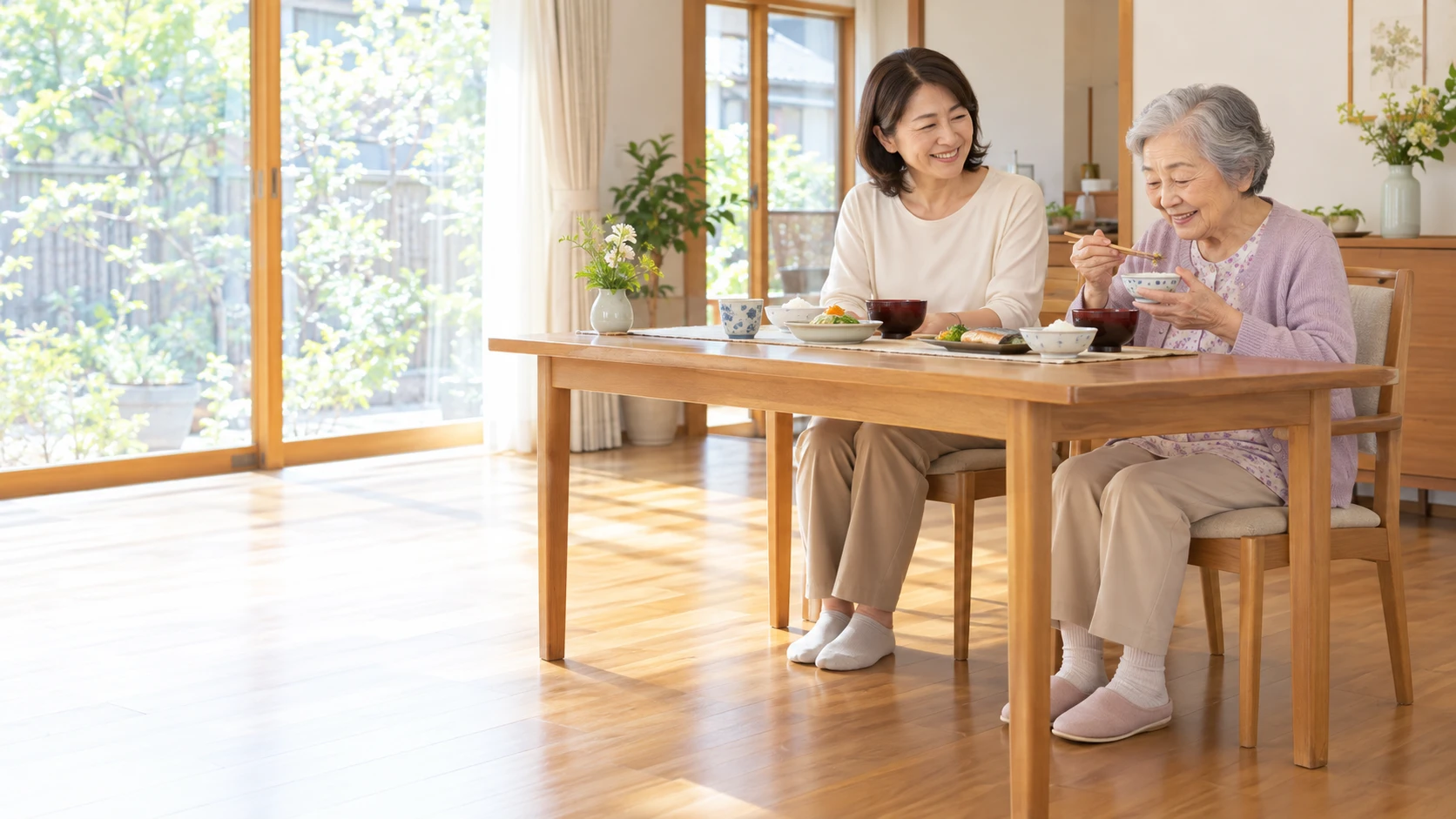
Make sure the soles of the feet rest firmly on the floor
If the chair is too high, the feet can't reach the floor and the body tends to become unstable.
Aim for a height where the whole sole of the foot rests on the floor or a footrest.
A good guide is a posture with the knees at about 90 degrees and the toes roughly below the knees.
Sit well back and support the back
Sitting on the edge of the seat makes the body slide forward easily.
Sit well back in the chair and use the backrest to support the body.
Using cushions as needed can make it easier to keep a stable posture.
Table height matters too
If the table is too high, the shoulders rise and the arms tend to tense up.
On the other hand, if it's too low, the person leans forward and eating can become harder.
Aim for a table height around the navel when sitting well back in the chair.
*For small people with a rounded back, food in the dish can be hard to see at a standard table height, which can take away their appetite. In such cases, we recommend preparing a table as low as possible so the food can be seen.
There are things only family can do
In mealtime assistance, creating surroundings where the person can eat with peace of mind matters more than special techniques.
Even small adjustments to the height of the chair or table can make eating easier.
Because meals happen every day, aim for a comfortable posture.
Summary
The cause of difficulty eating may lie not only with the person but also in surroundings such as the chair and table. Start by reviewing the surroundings.
- The soles of the feet rest on the floor or a footrest
- The knees are at about 90 degrees
- The table is around navel height
- A chair they can sit well back in, with support for the back
Setting up surroundings like these can make it easier to eat with peace of mind.
Meals are not only for nutrition but also a time to enjoy each day. Let's aim for comfortable surroundings so the person can keep eating with peace of mind.
Feel free to ask us on LINE*This article introduces general ideas about mealtime assistance. If difficulty swallowing or choking continues, please consult professionals such as a doctor, speech-language-hearing therapist or physical therapist about posture and eating methods suited to the person's physical condition.
Reference: "1-pun de wakaru shinjin kaigoshoku no chō kihon" (Shoeisha) (in Japanese)