Does the same posture go on for a long time?
When caring for a family member, do you ever feel:
- They sleep in the same posture for a long time.
- I don't know where to place the cushion.
- I wonder if this is really making them comfortable.
In fact, just adjusting a little where the body is supported can sometimes reduce the strain on it.
This kind of care in supporting the body is called "positioning."
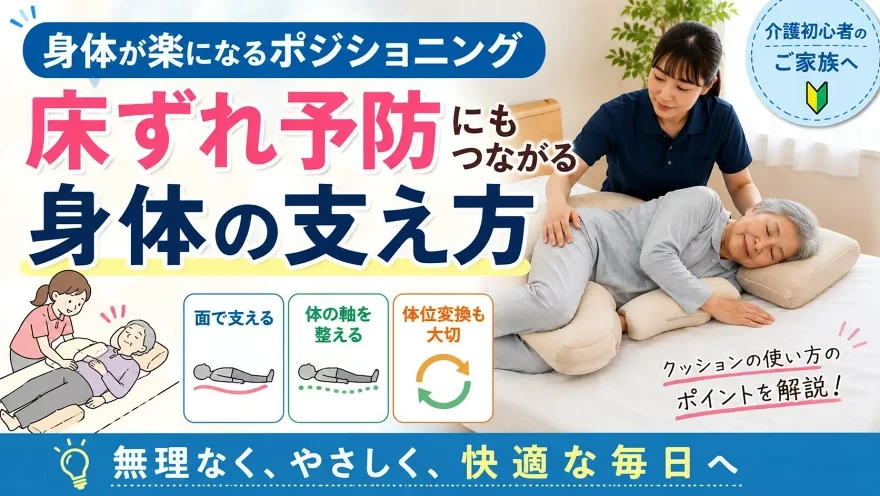
Support the body over a surface, not at a point
In positioning, it is important not to support just one part of the body, but to support it over as wide a surface as possible.
For example, if you place a cushion only at the knees of someone lying on their side, the force tends to concentrate on that part alone.
If instead you place the cushion so that it supports from the thigh to the toes, the body is supported over a wide surface, and the load is more easily spread.
A positioning cushion (shaped something like a body pillow) can also be useful.
Keep the body's axis in a natural state
Even when lying on the back, if the body is twisted or tilted, the load tends to concentrate on one part.
It is important to support the body so that its axis — from the head through the back and pelvis to the feet — is in a natural state.
Using cushions at the head and feet as needed also makes it easier to keep a comfortable posture.
It also matters not to stay in the same posture for a long time
When the same posture continues for a long time, pressure keeps being applied to the same place on the body.
For that reason, changing position so that the same posture does not continue for a long time is generally recommended.
About every two hours or less is sometimes given as a guide, but the appropriate interval differs with the person's physical condition and the mattress used.
Please do this in consultation with care and medical professionals.
Using assistive devices is one option
There is also the option of using assistive devices to reduce the strain on the body.
For example:
- Positioning pillows
- Pressure-redistributing mattresses
Combining these makes it easier to keep a comfortable posture, and also lightens the load on the person assisting.
There are things only family can do
Positioning is not a technique with one clear right answer.
- Support the body over a wide surface
- Bring the body's axis into a natural state
Just keeping these two things in mind can help the person spend their time more comfortably.
There is no need to aim for perfection from the start.
It is fine to learn little by little.
When in difficulty, consult a professional
If you are unsure where to place cushions, or if there is redness or pain on the body, try consulting a physical therapist, occupational therapist, visiting nurse or similar.
They may be able to teach you a method suited to the person's body and bed setup.
Summary
In positioning, it is important to support the body over a surface rather than at a point.
Also, bringing the body's axis into a natural state and changing position as needed makes it easier to reduce the strain on the body.
Assisting does not require special strength; what matters is thinking about the posture in which the body is at ease.
Small daily adjustments lead to comfortable time for the person.
References: Japanese Society of Pressure Ulcers, "Guidelines for the Prevention and Management of Pressure Ulcers (4th edition)"; Noriki Ukita, Associate Professor, Department of Rehabilitation, Faculty of Health Sciences, Tohoku Fukushi University, webinar 「褥瘡予防のための福祉用具活用とポジショニング ~臥位と座位のチェックポイント~」 (on assistive devices and positioning for pressure ulcer prevention; attended in 2026, Japanese)
* This article is restructured for families who have just begun caregiving, with reference to what we learned in Mr. Ukita's webinar. The suitable positioning and way of changing position differ with the person's physical condition. If redness of the skin continues or there is pain, please consult a professional such as a physical therapist, occupational therapist or visiting nurse early.
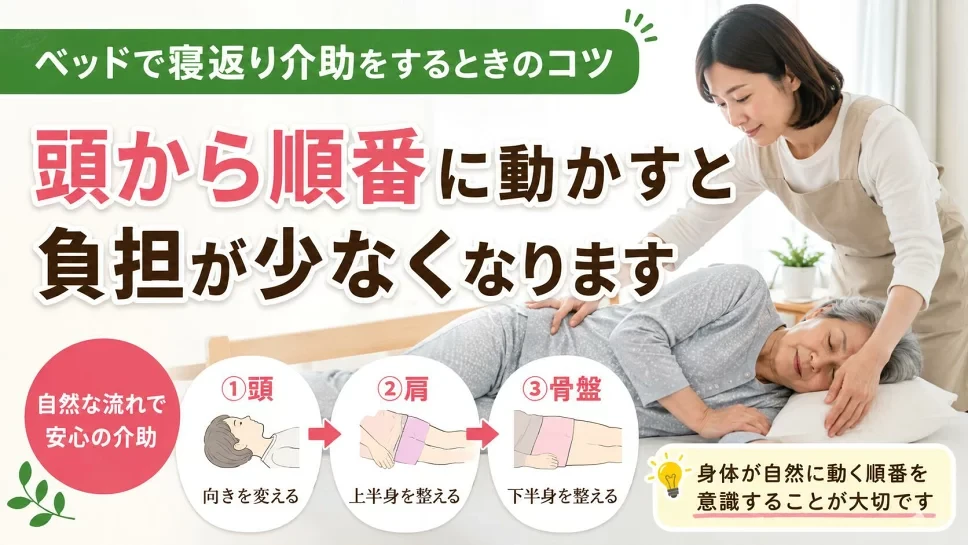
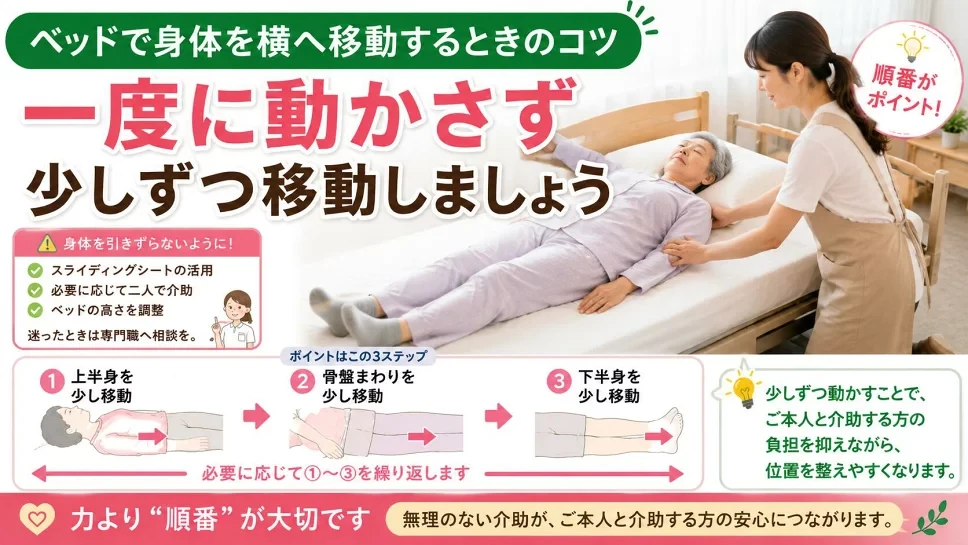
Tips for helping someone turn over in bed Tips for moving the body sideways in bed Why do pressure sores form? What are the signs of a pressure sore? Sitting in a wheelchair to prevent pressure sores