Why do pressure sores form?
When caring for someone, you may be told:
- Be careful about pressure sores.
But have you ever wondered:
- Why do pressure sores form?
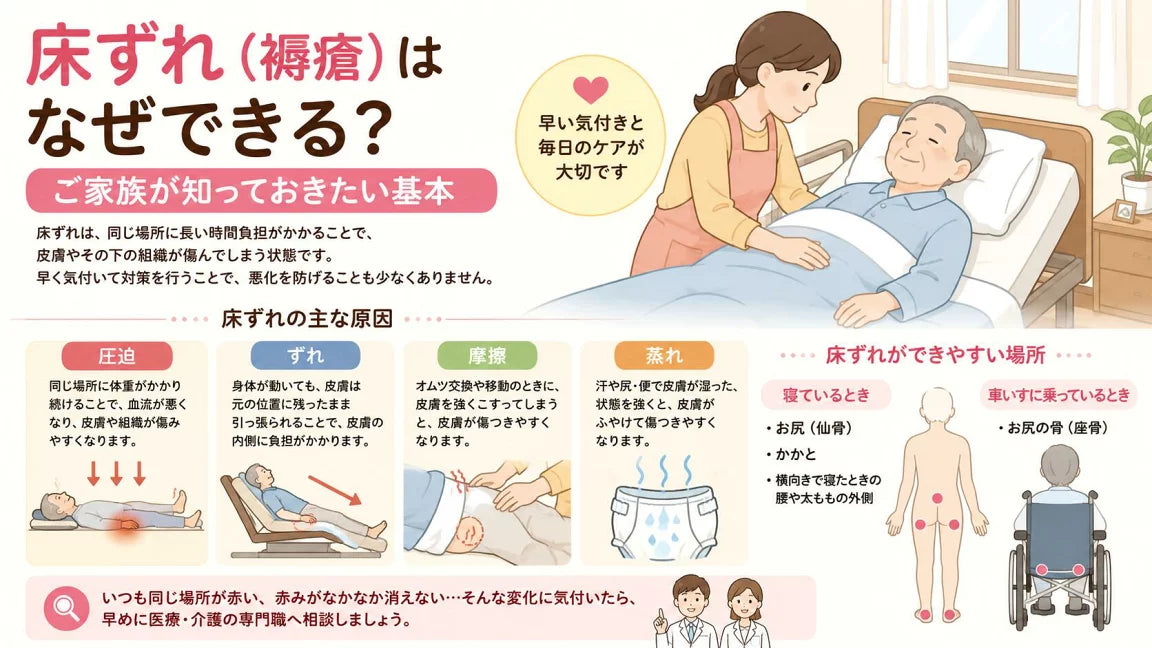
Pressure sores (bedsores) are called "jokuso" (pressure ulcers) in medical and care settings in Japan.
They are a condition in which the skin and the tissue beneath it are damaged because a load is placed on the same spot for a long time.
Noticing early — for example, that the skin has turned red — and taking measures can often prevent them from getting worse.
The main cause of pressure sores is pressure
Gravity is always acting on our bodies.
Whether lying down or sitting, body weight tends to concentrate on the places where bones stick out.
If that continues for a long time, the flow of blood beneath the skin worsens, and the skin and tissue become easily damaged.
This is the biggest cause of pressure sores.
"Shear" and "friction" are causes too
Pressure sores are not caused by pressure alone.
For example, when the back of the bed is raised, the body alone may slide down a little, while the skin stays where it was and is pulled.
This kind of "shear" also puts a load on the inside of the skin and can cause pressure sores.
Also, if the skin is rubbed hard during diaper changes or transfers, "friction" can make the skin easier to damage.
Dampness weakens the skin
For people who sweat easily, or who have urinary or fecal incontinence, the skin can easily become damp.
When the skin is softened by moisture, even a slight stimulus can damage it.
So it is also important to keep the skin clean and not let it stay damp.
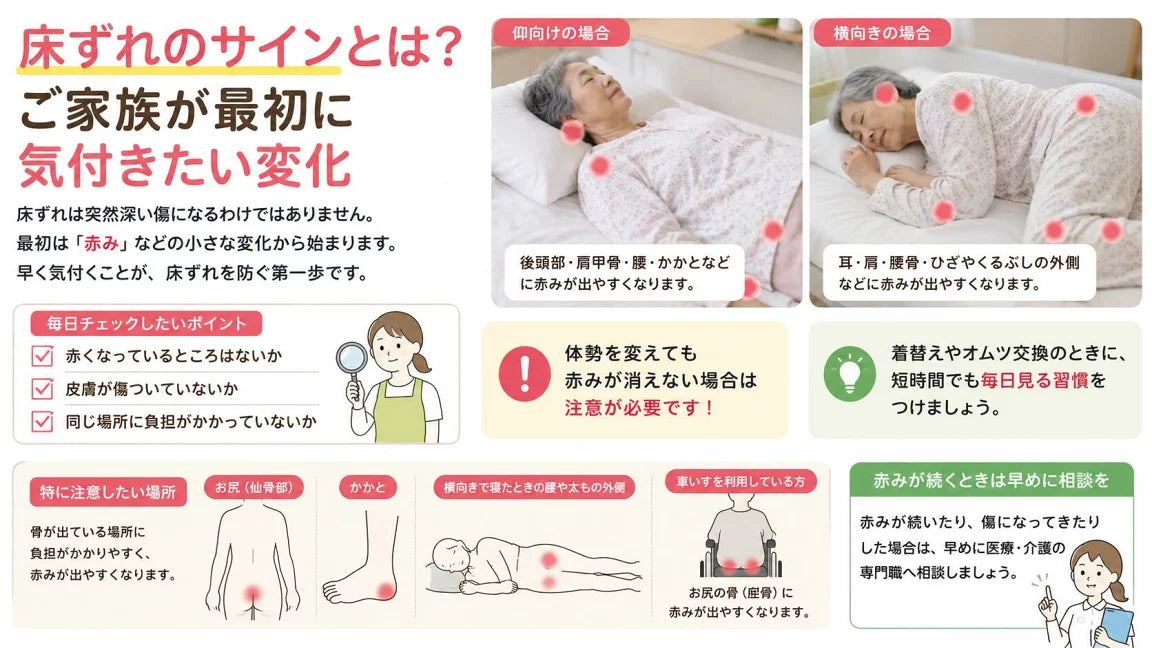
Where pressure sores tend to form
Pressure sores are known to form easily where bones stick out.
For example:
- The buttocks (sacrum)
- The heels
- The hip and outer thigh when lying on one's side
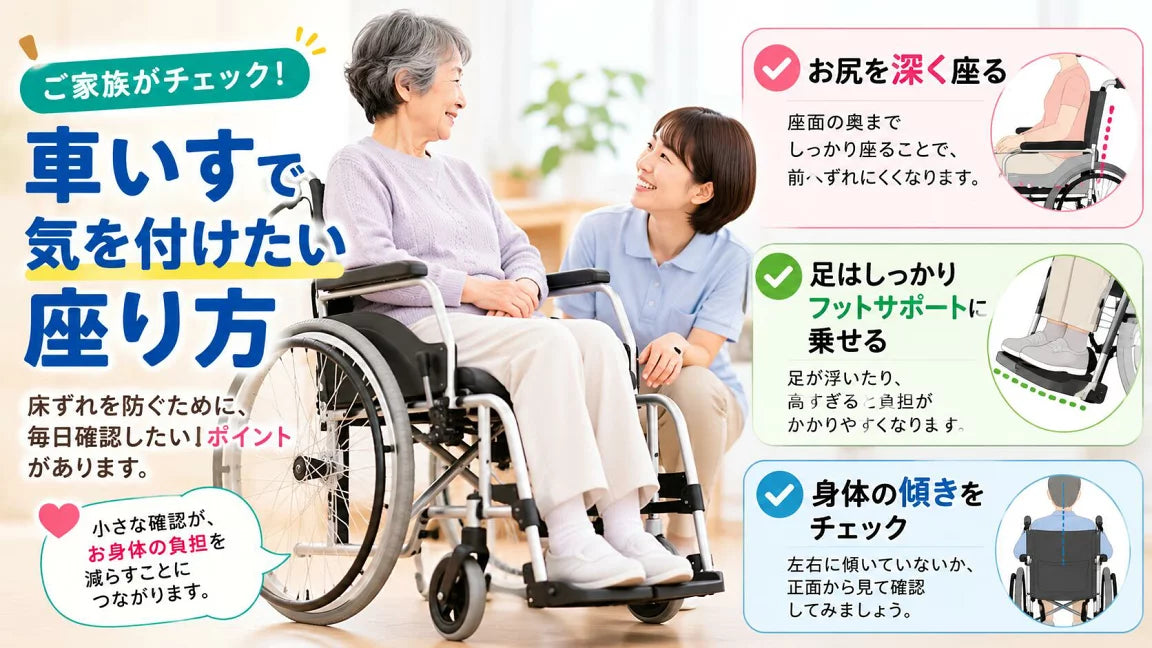
For people who use a wheelchair, care is also needed around the sitting bones (ischium).
There are things only family can notice
A pressure sore does not suddenly become a deep wound.
At first, the skin may turn red.
- The same spot is always red.
- The redness doesn't go away.
If you notice changes like these, consult a medical or care professional early.
Responding at an early stage can prevent it from getting worse.
Summary
Pressure sores become more likely when "pressure," "shear," "friction" and "dampness" overlap.
What matters most is to keep a load from staying on the same spot.
Because family look after the person every day, they can notice small changes in the skin.
- It might be a little red.
A small observation like that can lead to preventing pressure sores.
References: Japanese Society of Pressure Ulcers, "Guidelines for the Prevention and Management of Pressure Ulcers (4th edition)"; Noriki Ukita, Associate Professor, Department of Rehabilitation, Faculty of Health Sciences, Tohoku Fukushi University, webinar 「褥瘡予防のための福祉用具活用とポジショニング ~臥位と座位のチェックポイント~」 (on assistive devices and positioning for pressure ulcer prevention; attended in 2026, Japanese)
* This article is restructured for families who have just begun caregiving, with reference to what we learned in Mr. Ukita's webinar. If a pressure sore is suspected or redness of the skin continues, please consult a medical or care professional early.