Does helping someone turn over take strength?
When you begin caring for a family member, do you ever feel:
- It's hard to help them turn over.
- It takes strength and wears me out.
- I wonder if this hurts them.
In fact, helping someone turn over is not something done by strength alone.
By being aware of the order in which the body naturally moves, you can sometimes lessen the strain on the person.
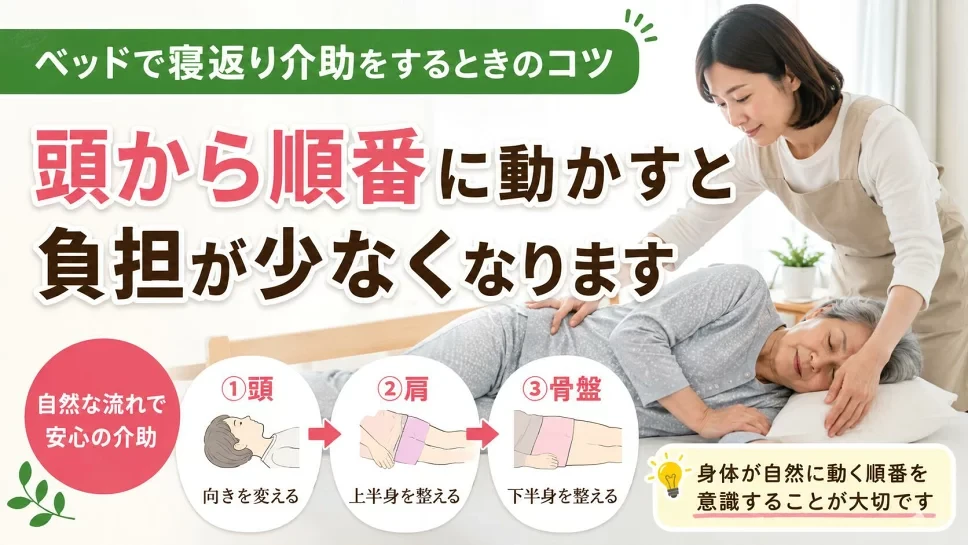
Moving in order from the head matters
When helping someone turn over, assisting in the order of head, shoulders and then pelvis makes it easier for the body to move naturally.
When we turn over ourselves, the head changes direction first, the shoulders and trunk follow that movement, and the pelvis moves last.
Keeping the same flow in mind when assisting leads to a movement with less strain.
Why start from the head?
The head has the role of leading the movement of the whole body.
When the head moves first, the person can more easily get ready to move and may find it easier to cooperate with the movement.
So assisting in order from the head also helps draw out the person's own cooperative movement.
The shoulders and pelvis have important roles too
After the head come the shoulders, and after that the pelvis.
The shoulders bring together the movement of the upper body and arms.
The pelvis is an important part that controls the movement of the lower body.
Moving the body in this order helps the whole body move together naturally.
It also matters not to force the movement
In assisting, if you think:
- Let's move quickly
- Let's get it done in one go
you can end up putting strain on the body instead.
Assisting little by little, in step with the body's natural movement, makes it easier to change position with peace of mind.
There are things only family can do
In caregiving, simply knowing the right order can sometimes reduce the strain on the person.
It is fine if you cannot do it well from the start.
Being aware of the flow in which the body naturally moves is the first step toward gentle assistance.
When in difficulty, consult a professional
If helping the person turn over is difficult, or if there is pain, try consulting a physical therapist, occupational therapist, visiting nurse or similar.
They may be able to teach you a way of assisting suited to the person's physical condition.
Summary
In helping someone turn over, it is important to be aware of the order in which the body naturally moves.
Assisting in the flow of head, shoulders, pelvis can sometimes reduce the strain on the person.
Assisting is not about moving someone by force.
Matching the flow in which the person's body originally moves leads to days spent with peace of mind.
References: Japanese Society of Pressure Ulcers, "Guidelines for the Prevention and Management of Pressure Ulcers (4th edition)"; Noriki Ukita, Associate Professor, Department of Rehabilitation, Faculty of Health Sciences, Tohoku Fukushi University, webinar 「褥瘡予防のための福祉用具活用とポジショニング ~臥位と座位のチェックポイント~」 (on assistive devices and positioning for pressure ulcer prevention; attended in 2026, Japanese)
* This article is restructured for families who have just begun caregiving, with reference to what we learned in Mr. Ukita's webinar. The suitable way of assisting differs with the person's physical condition. If there is pain during assistance or you are unsure of the method, please consult a professional such as a physical therapist, occupational therapist or visiting nurse.
Tips for moving the body sideways in bed Why do pressure sores form? What are the signs of a pressure sore? Sitting in a wheelchair to prevent pressure sores Positioning that eases the body