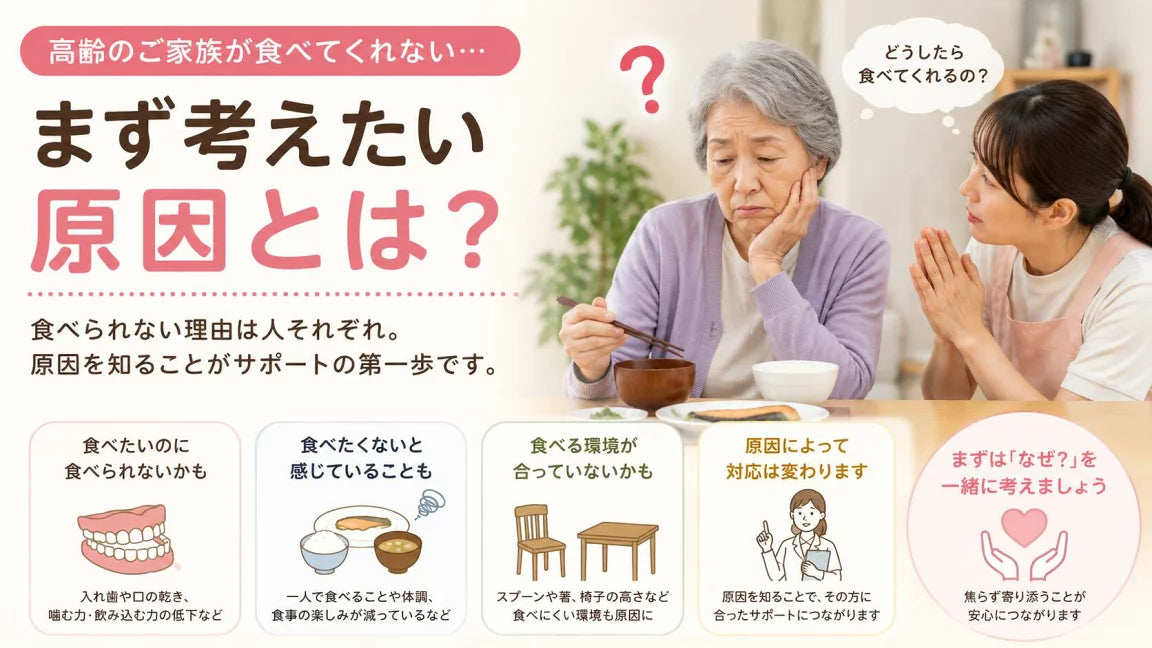
Are you worrying, "How can I get them to eat?"
They used to eat well, but recently are you being told:
- I'm already full.
- I have no appetite.
- I don't want any.
As family, it is natural to worry:
- I want them to eat more.
- At this rate, won't they lose their strength?
But before that, there is something we would like you to consider.
That is: "Why can't they eat?"
In fact, behind the behavior of "not eating," various reasons may be hidden.
Perhaps they "want to eat but can't"
Even when it looks as if there is no appetite, there are cases where the person really does want to eat but eating has become difficult.
For example:
- Their dentures no longer fit
- Their mouth is dry and food is hard to eat
- Chewing or swallowing has become hard work
- A spoon or chopsticks are hard to use
- The table or chair is the wrong height, putting them in a posture that makes eating hard
In cases like these, the cause may be not appetite itself but the eating environment or the condition of the mouth.
They may also feel they "don't want to eat"
On the other hand, appetite may truly have dropped.
For example:
- They now often eat alone
- Shopping and cooking have become a burden
- They are not feeling well
- Food no longer tastes as good as it used to
A meal is not only for taking in nutrition; it is also a time of enjoyment and a change of mood.
When the enjoyment of eating lessens, appetite can naturally drop.
The reason for "not eating" differs from person to person
Even when the amount eaten has fallen in the same way, the cause differs from person to person.
For example, there are people who say:
- Once my dentures were adjusted, I could eat again.
and there are people who say:
- Once I started eating with the family, my appetite came back.
So before thinking "they won't eat, so let's get them to eat such-and-such," it is important to think about why they cannot eat.
The response changes with the cause
Even when the result — "not eating" — is the same, the reason differs for each person.
That is why the first thing that matters is to think not about "how to get them to eat," but about "why they can't eat."
Understanding the cause can lead to adjustments and support suited to the person.
When it is hard for the family alone to judge, it is also important to consult professionals such as the doctor, a dentist or a registered dietitian.
Summary
When an older family member won't eat, the family worries a great deal.
However, even when it looks as if there is no appetite, it is not uncommon for the person to "want to eat but be unable to."
First, knowing the reason for not eating is the first step toward support suited to the person.
Rather than hurrying to make them eat, it is important to watch how they are from the viewpoint of "I wonder why they can't eat."
Reference: Kiyoyo Ito, home-visit registered dietitian, Naito Clinic (Seijitsukai Medical Corporation), webinar 「お食事・栄養の困りごとを解決!明日から使える、お手軽&安心安全な食事提供のコツ」 (on easy, safe ways of providing meals; attended in 2026, Japanese)
* This article is restructured for families who have just begun caregiving, with reference to what we learned in Ms. Ito's webinar. If there is a sudden drop in food intake, weight loss, or continued choking during meals, please consult a medical institution early.