Are you keeping it up "for the sake of health"?
When preparing meals for an older family member, many people probably think:
- Go easy on the salt.
- It's better to cut down on carbohydrates.
- It's better to avoid greasy food.
Of course, when a doctor has given instructions on dietary restrictions, it is important to follow them.
However, when the amount eaten is itself decreasing, a slightly different viewpoint can also be needed.
"Undernutrition" can become a problem
As people age, some lose their appetite or can eat less at one time.
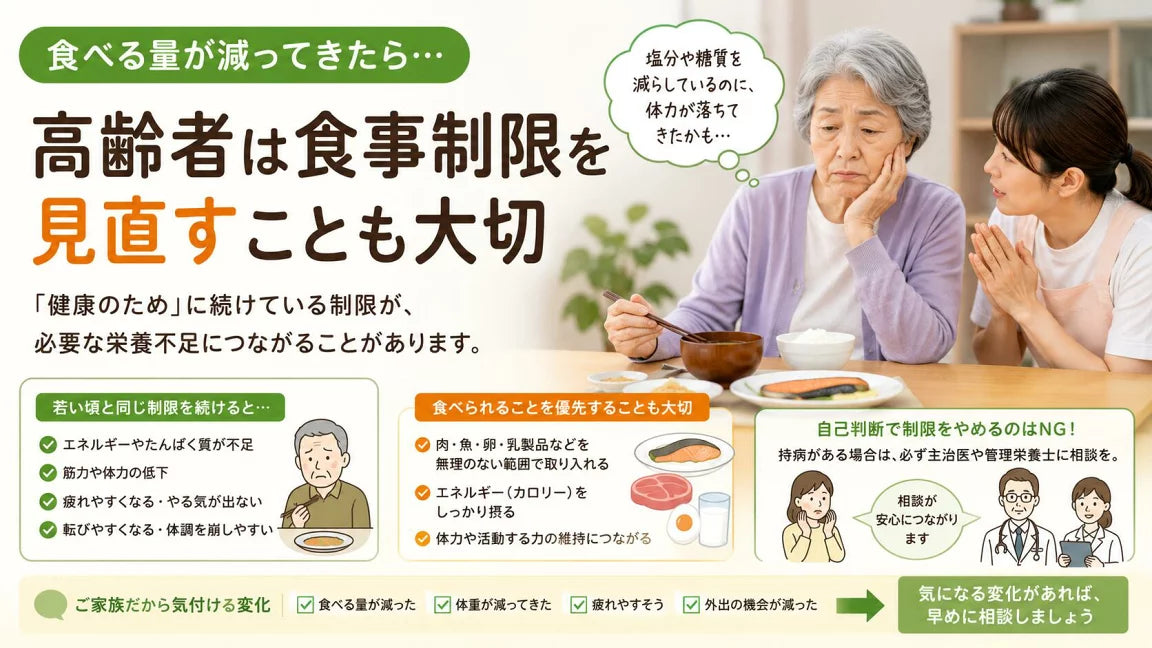
If, in that state, restrictions on carbohydrates, fat, salt and so on are continued just as when younger, even the energy and protein the body needs can run short.
This state is called "undernutrition."
With undernutrition, effects can appear in daily life too, such as:
- Muscle strength declines
- Tiring more easily
- Falling more easily
- Getting unwell more easily
- Motivation tends to fade
- Going out less often
When the amount eaten has decreased
When the amount eaten has decreased, let us review the meals as a whole.
For example, you may come across information such as:
- Salt: up to 6 g a day.
- Cut down on carbohydrates as much as possible.
However, for a person whose intake has fallen a great deal, putting restrictions first too much can take away even the feeling of "I want to eat."
If you feel they are eating less, it also matters to think first from the viewpoint of "Are they getting enough food?"
Sometimes being able to eat comes first
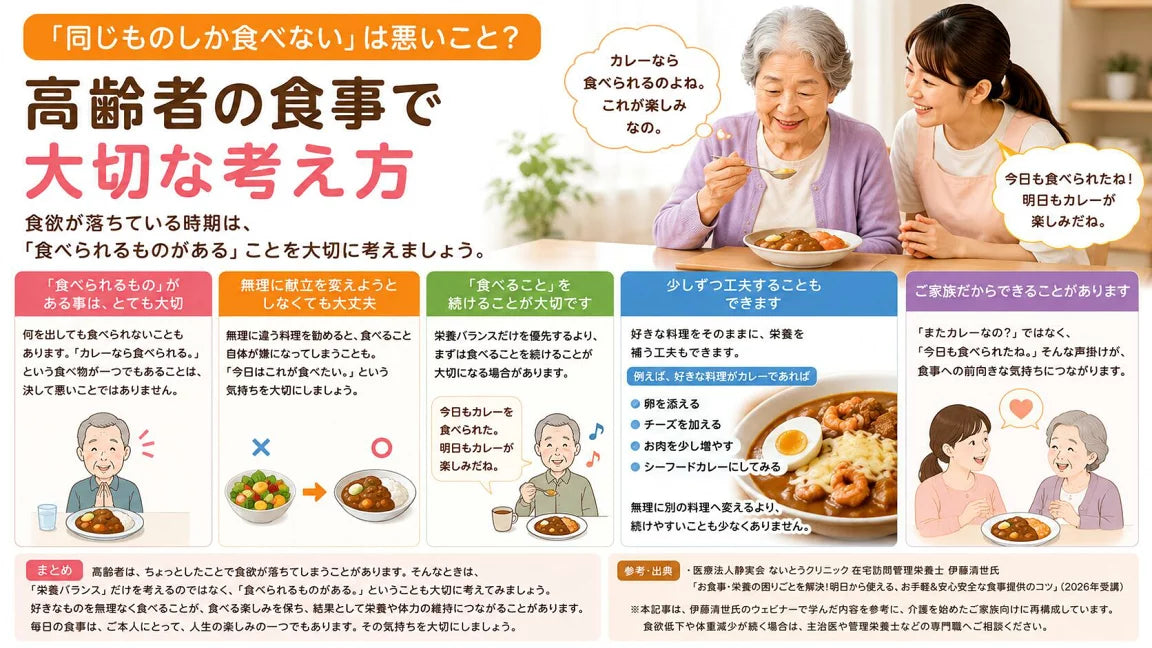
For older people, there are cases where "taking in the necessary nutrition properly" matters more than "balancing nutrition."
For example, including meat, fish, eggs, dairy products and so on within comfortable limits makes it easier to supply the protein needed for building muscle.
Also, taking in enough energy (calories) helps maintain the strength to be active and physical stamina.
Avoid stopping dietary restrictions on your own judgment
On the other hand, some people have chronic conditions and have received instructions about meals from their doctor.
In that case, stopping dietary restrictions on your own judgment is not recommended.
If you feel:
- They've been eating less lately.
- Their weight has been dropping.
consult the doctor or a registered dietitian and have them confirm a diet suited to the person's current physical condition.
There are changes only family can notice
For example:
- Eating less than before
- Weight dropping little by little
- Seeming to tire easily
- Going out less often
Changes like these can be signs of a lack of nutrition.
There are changes that can be noticed precisely because family spend every day together with the person.
Summary
As people get older, there are situations where "taking in the necessary nutrition properly" matters more than "continuing dietary restrictions."
When the amount eaten is decreasing, let us not forget to ask whether nutrition is running short.
For those with an illness that requires dietary restrictions, it is important not to change things on your own judgment, but to think about meals suited to the body as it is now while consulting the doctor or a registered dietitian.
Reference: Kiyoyo Ito, home-visit registered dietitian, Naito Clinic (Seijitsukai Medical Corporation), webinar 「お食事・栄養の困りごとを解決!明日から使える、お手軽&安心安全な食事提供のコツ」 (on easy, safe ways of providing meals; attended in 2026, Japanese)
* This article is restructured for families who have just begun caregiving, with reference to what we learned in Ms. Ito's webinar. Whether dietary restrictions are needed differs with the illness and physical condition. Those under treatment should consult the doctor, a registered dietitian or another professional.