Do you feel they "can't eat much any more"?
They used to eat well, but recently, do they say things like:
- I'm already full.
- I'm not hungry.
Has this been happening?
As a family member, you may worry:
- If she doesn't eat more, she'll lose her strength.
It's natural to feel this way.
In fact, there are reasons why appetite tends to decrease with age.
Reason ① Less activity means eating less
As people age, more of them spend less time moving their bodies than when they were younger.
As a result, they need less energy, and the amount they eat may naturally decrease.
Not being able to eat the same amount as before is not necessarily abnormal in itself.
Reason ② Taste and smell can become harder to sense
With age, the senses of taste and smell can gradually change.
As a result, food may feel less "delicious" than before, and the person may not eat as much.
Reason ③ Eating itself may have become hard work
When the strength to chew and swallow weakens, the meal itself can become a burden.
Sometimes it is not that they "don't want to eat", but that "eating tires them out".
Reason ④ Changes in physical condition also play a part
Especially in summer, the heat can reduce appetite.
Appetite can also fall when lack of sleep, constipation or other changes in condition continue.
Don't push too hard with "eat more"
When someone eats less, it's natural to worry.
But being told "eat more" again and again can make the meal itself a burden.
First, it is also important to respect the amount they can eat.
It's fine not to insist on three meals
Sometimes people cannot eat enough in just three meals: breakfast, lunch and dinner.
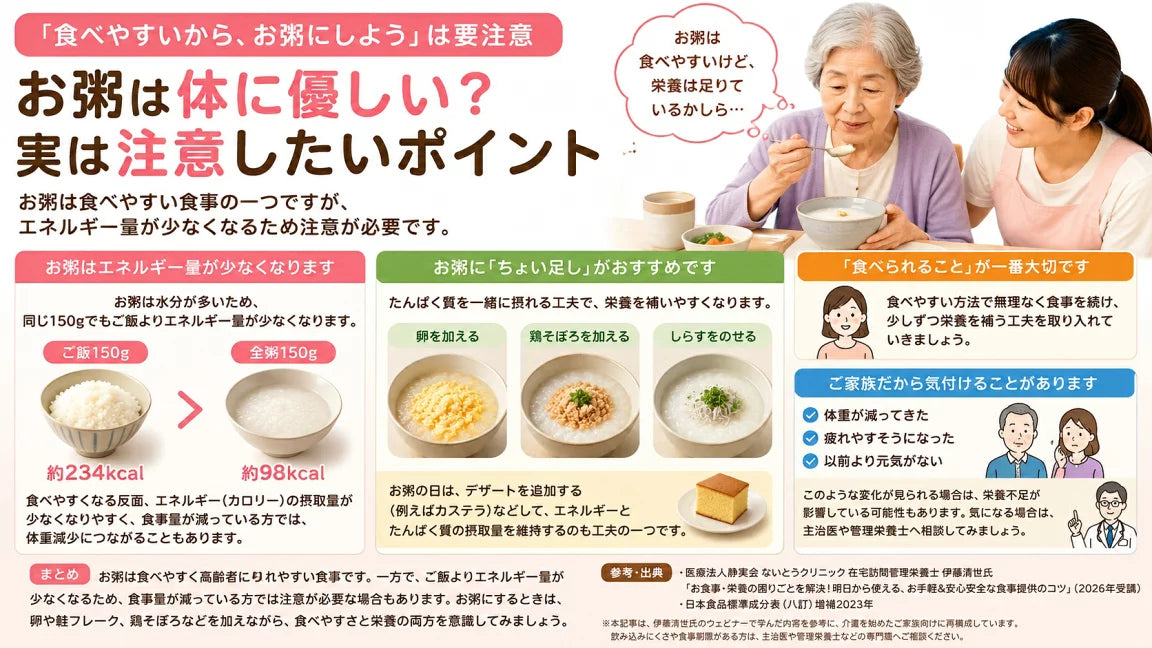
In that case, one approach is not to insist on three meals, but to eat a little whenever they can.
For example:
- Fruit
- Yoghurt
- Cheese
- Tofu
- Chawanmushi (savoury egg custard)
- Egg dishes
- Warm soup
You can add foods like these little by little whenever they can eat.
Even if each meal is small, it is also important to increase how much they can eat over the whole day.
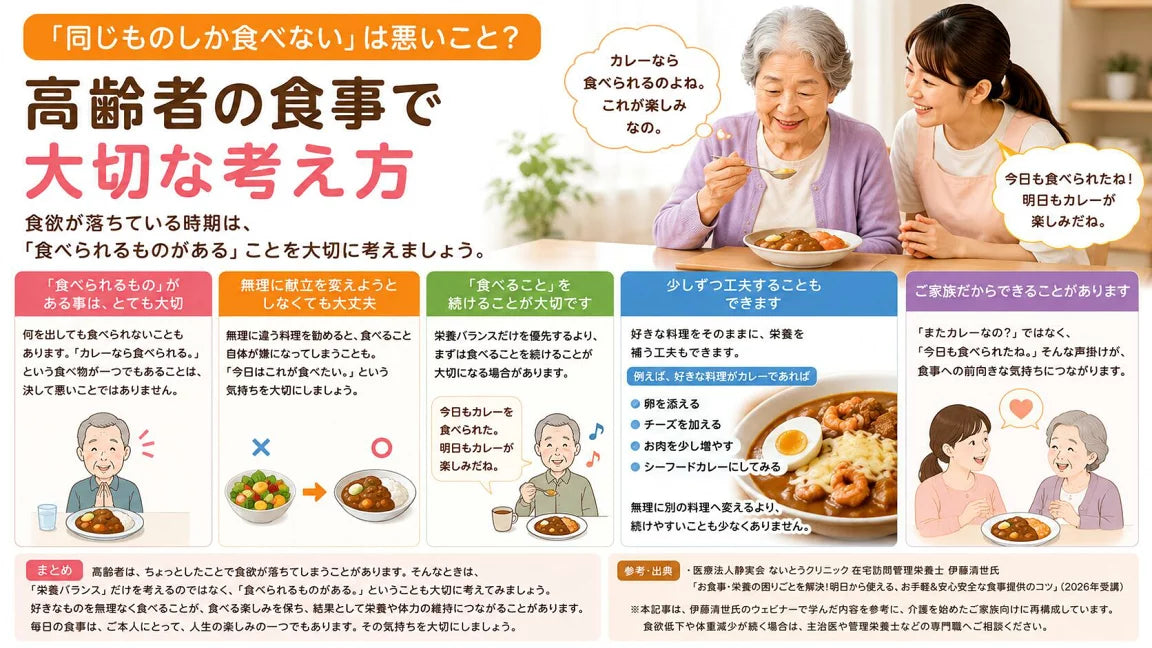
Look for "foods they can eat" together
Nutritional balance matters too, but when appetite is low, the first thing that matters is "being able to eat".
Something they like, something easy to eat, something they feel like eating that day.
Starting with just one dish like that is enough.
What families do
How families cope when appetite falls varies from home to home.
Some families add, little by little, foods that the person says "I can eat this" about.
Valuing the accumulation of "I managed to eat a little today", rather than "what to eat", is also one way families can support the person.
Don't forget fluids
When people eat less, they also tend to run short of fluids.
Try to encourage frequent drinks, not only food.
Some things only family members notice
For example:
- They eat much less than before
- They are losing weight
- Meals have started to take a long time
- They no longer eat even foods they used to love
Changes like these are easier to notice precisely because family members see the person every day.
Don't assume "it's just their age". If changes continue, it is also important to consult the attending doctor.
Ask for advice early in cases like these
- They can hardly eat for several days
- They have suddenly lost weight
- They choke or cough at every meal
- They seem to be in discomfort when eating
In such cases, an illness or a weakening ability to swallow may be behind it.
Consult a medical institution early.
Clothing can also make mealtimes more comfortable
During meals, people may stay seated for a long time.
Clothing that does not squeeze the stomach and clothing that lets the person sit comfortably make mealtimes easier to enjoy.
- Lately her stomach looks uncomfortable.
- He loosens his trousers after meals.
If you notice signs like these, reviewing their clothing is one option.
If you are unsure about clothing, ask Setagaya Kaigo
At Setagaya Kaigo, we listen to things such as:
- The person's physical condition
- Their posture while eating
- Comfort in everyday life
- How easy it is to change
and suggest care clothing that suits the person.
Please feel free to ask us.
Trousers we recommend that are easy on the stomach



Summary
With age, changes in activity and in how the body works can gradually reduce appetite.
Even so, getting the person to eat a lot is not necessarily the right answer.
First, it is important to respect the amount they can eat and to keep eating without strain, including foods that are easy to eat and foods they like.
And if changes such as:
- They've been eating much less lately.
- They're losing weight.
continue, consult the attending doctor early.
Daily meals are a time to take in nutrition, and at the same time a time of enjoyment for the person.
Valuing the person's own pace, and without rushing, let's support mealtimes together as a family.
*This article is based on general thinking as of July 2026. If there is a sudden loss of appetite, weight loss or choking during meals, please consult a medical institution early.
References and sources: National Center for Geriatrics and Gerontology, "About loss of appetite in older people: why do we lose our appetite as we age?"; Ministry of Health, Labour and Welfare, "Nutrition and food education measures"; Ministry of Agriculture, Forestry and Fisheries, "Promoting food education for older people" (in Japanese)