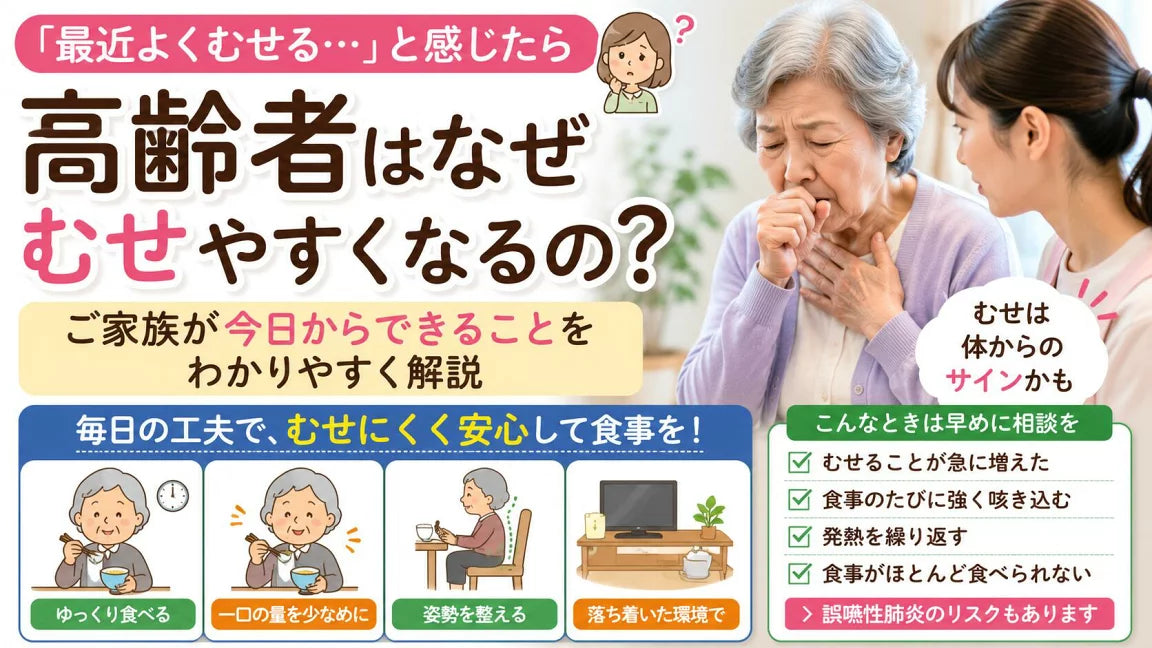
Have you felt "they often choke during meals lately"?
They used to eat without any trouble, but recently do you notice:
- They've started choking on tea.
- They cough at every meal.
As family, it is natural to worry:
- Is food or drink getting into the windpipe more easily?
- Are they aspirating?
- What if it turns into pneumonia?
In fact, it is not unusual to choke more easily with age.
The first step is to know the reasons.
Reason 1: The strength to swallow can gradually weaken
Food and drink are sent from the mouth to the esophagus.
With age, the muscles that help that movement can gradually weaken.
As a result, the timing of swallowing can be off, and the person chokes.
Reason 2: Saliva can decrease
Saliva works to make food easier to swallow.
With age, saliva can decrease, and the mouth dries out more easily.
As a result, food is harder to form into a mass, and choking becomes more likely.
Reason 3: Eating in a hurry makes choking more likely
When eating is rushed, the timing of swallowing can be off, and choking becomes more likely.
In particular, eating in a hurry while talking can make swallowing harder.
Reason 4: Physical condition and illness can have an effect too
When someone has a cold, is feeling unwell, or is affected by an illness, the strength to swallow can also weaken.
If choking has suddenly become more frequent, it is also important to consult the doctor.
Value time to eat slowly
Eating slowly, one mouthful at a time, can make swallowing easier.
Let us value being able to eat with peace of mind over how soon the meal is finished.
Try making each mouthful a little smaller
With age, the appropriate size of a mouthful can drift away from what the person themselves thinks it is.
Just consciously making each mouthful a little smaller can make choking less likely.
Posture matters during meals too
During meals, it is important to sit well back in the chair, with the feet on the floor or a footrest, in a posture that keeps the body stable.
Eating in a stable posture can make swallowing easier.
It helps the movement of the mouth and tongue, and also helps prevent aspiration, in which food enters the airway.
Create an environment for concentrating on the meal
Eating in a hurry while watching television, or in a hectic environment, can make it harder to concentrate on swallowing.
An environment in which the person can eat calmly matters too.
There are things only family can notice
For example:
- They have started choking on tea often
- They cough at every meal
- Their voice is hoarse after meals
- Meals have started taking longer
Changes like these are easy to notice precisely because family see the person every day.
"Maybe they've been choking a little more lately." Even a small change like that may be an important sign.
Consult early in cases like these
In cases like the following, we recommend consulting the doctor.
- Choking has suddenly become more frequent
- They cough hard at every meal
- Fever keeps recurring
- They can hardly eat their meals
When the decline in swallowing strength is progressing, or when choking continues, food and drink can enter the windpipe and lead to aspiration pneumonia.
Clothing that makes meals easier adds to comfort too
During meals, a person may spend a long time sitting.
Clothing that does not squeeze the waist, and clothing that does not become uncomfortable while sitting, makes mealtimes easier to spend comfortably.
Also, front-opening clothing is easy to change even on days when the person is not feeling well, and can be helpful when receiving assistance.
Here are examples of pants that do not squeeze the waist and do not become uncomfortable while sitting.
Pants we recommend for comfort around the waist
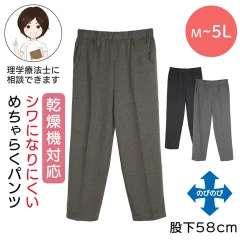
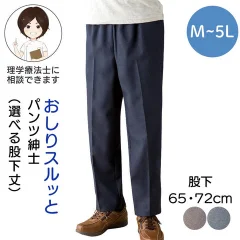
If you are unsure about clothing, come to Setagaya Kaigo
At Setagaya Kaigo, we ask about things such as:
- The person's physical condition
- Posture during meals
- Everyday comfort
- Ease of changing
and suggest care clothing suited to that person.
Please feel free to ask us.
Feel free to ask us on LINESummary
As people get older, the strength to swallow, the amount of saliva and so on change little by little, and choking can become more likely.
Even so, there is no need to conclude that "it's age, so it can't be helped."
Small daily adjustments — eating slowly, taking smaller mouthfuls, setting up posture for meals — can make eating easier.
And if choking increases or eating becomes difficult, consult the doctor or a speech-language-hearing therapist (ST) early.
Daily meals are not only for taking in nutrition; they are also a time the person looks forward to.
So that they can go on eating with peace of mind, let us watch over them while respecting their own pace.
* This article is based on general thinking as of July 2026. If choking continues, or fever, reduced food intake or the like is seen, please consult a medical institution early.
References: Japan Society of Clinical Otorhinolaryngology, "Swallowing disorders"; Taiseikai Group, 『1分でわかる 新人介護職の超きほん』 (The very basics for new care workers, in one minute), Shoeisha, 2026 (Japanese)