When it comes to clothing for someone wearing a brace around the ankle, people often wonder:
- The trouser hems catch on the brace, so they're hard to put on
- What kind of socks should we choose?
These are common questions.
Ankle braces come in many types: plastic ones, ones with metal uprights, ones built into the shoe, and more.
In this article, with supervision from Setagaya Kaigo's occupational therapist, we look at points for choosing trousers and socks, assuming a commonly used plastic ankle-foot orthosis (AFO).
*Even among AFOs, shapes and lengths vary, from ones reaching just above the ankle bone to ones covering the calf. Please check against the brace actually being used.
First, check the order for putting on the brace
With a plastic AFO, the usual order is as follows.
- Put on the socks
- Put on the trousers
- Roll up the trouser hems
- Put on the brace
- Roll the trouser hems back down
Because the brace holds the ankle in place, it's important that the trouser hems can be rolled up well enough before the brace goes on.
Socks, on the other hand, sit between the brace and the skin and ease rubbing and pressure.
So trousers and socks each have different points to check.
Choosing trousers
1. Wide, stretchy hems
When putting on the brace, the trouser hems need to be rolled up toward the calf. Trousers like these are easier to use:
- Hems with a fair amount of width
- Stretchy fabric
- Hems that are easy to roll up
If the hems are narrow or the fabric barely stretches, you may not be able to roll them up far enough to fit the brace.
Trousers with a zip at the hem that opens wide are another option.
2. Measure the widest part of the brace
If you're unsure about hem width, measuring the brace actually in use makes it clearer. At Setagaya Kaigo, we use this as one guide:
Measure around the widest part of the brace, and check that the trouser hem circumference is about 5cm larger
For example, if the widest part of the brace measures 35cm around, trousers with a hem of about 40cm around are one guide.
However, the room needed depends on how the fabric stretches and the shape of the brace. As well as the numbers, check that the hems can actually be rolled up.
3. Wider isn't always better
Choosing extremely wide trousers just to fit the brace isn't the answer. Especially for people who walk, hems that are too wide can lead to:
- Catching on a walking stick
- Catching on shoes or the brace
- Treading on the hems
Choose a width with enough room for the brace that still doesn't get in the way when walking.
4. Trousers that aren't too long
For people who walk, trousers that are too long can lead to treading on the hems and falling. Stand with the brace and shoes on, and check that the hems don't touch the floor.
Having a brace doesn't mean the trousers need to be longer.
5. Not too long for wheelchair users, either
Because trouser hems ride up when sitting in a wheelchair, some families wonder:
- Wouldn't slightly longer trousers be better?
It's a natural thought.
But even wheelchair users stand up at times, such as moving to the toilet or transferring to bed. If the trousers are too long, they may tread on the hems then.
For wheelchair users too, allow room around the waist and hips, but choose an inseam that basically fits the person.
Trouser points in summary
- Room at the hems
- Fabric that stretches well
- Hems that are easy to roll up
- Not too long
- Not extremely wide
It's important to look at both: "the brace fits through" and "they can move safely once dressed".
Trousers with hems that roll up easily, for brace users
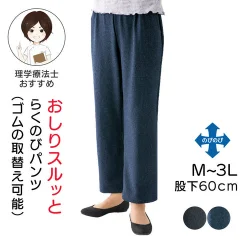 Oshiri Surutto Easy High-tension Pants (women's; very stretchy; easy to pull up even with one hand)The hem measures about 41cm around — on the wide side — and the fabric stretches well, so the hems roll up easily before putting on the brace. 60cm inseam, sizes M to 3L (women's).
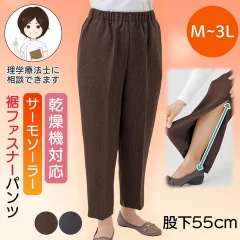 Hem-zip pants (women's, made in Japan, approx. 38 cm zip at the hem, dryer-safe)A zip of about 38cm at the hem opens it wide, so the brace goes through easily. 55cm inseam, sizes M to 3L (women's), dryer-safe.
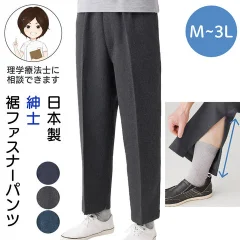 Hem-zip pants (men's, made in Japan, approx. 25 cm zip at the hem)A zip of about 25cm inside the hem opens with a simple pull, so the brace goes through easily. Sizes M to 3L (men's).
Choosing socks
1. Socks go under the brace
With a plastic AFO, the brace is basically put on over the socks.
What matters is that the brace doesn't touch the skin directly.
Direct contact can lead to rubbing and pressure, so a sock covers the skin between it and the brace.
2. Socks longer than the brace
AFOs vary in height: some reach just above the ankle bone, others cover the calf.
So check that the socks aren't shorter than the brace. They need to be long enough that the top edge of the brace doesn't touch the skin.
Checking the height of the brace before buying socks makes choosing easier.
3. Elastic that isn't too tight
People who wear a brace may have stiff ankles, paralysis or swelling. Socks with a cuff that isn't too tight and stretches well are easier to use.
The brace already holds the foot in place, so tight socks on top can make the pressure feel stronger. Especially with swelling, check that the elastic doesn't leave deep marks.
4. Watch for wrinkles and seams
Wrinkles or seams caught between the brace and the skin can put pressure on that spot. Socks like these are a good choice:
- Doesn't wrinkle easily
- Fits the foot reasonably well
- Seams that don't press on the skin
Especially when sensation is reduced, the person may not notice wrinkles or tightness. It's also important to check for redness or pressure marks after the brace comes off.
5. Check breathability too
Wearing a brace makes the feet prone to getting sweaty, so choosing absorbent, breathable materials is another point. Staying sweaty for long periods can lead to skin problems.
6. Beware of socks that are too thick
Worrying about rubbing doesn't mean thick socks are the answer. Shoes for brace users are sometimes sized to include the brace, so socks that are too thick can stop the shoe fitting over the brace.
Some people even wear different shoe sizes on the braced and unbraced sides.
When changing socks, check not only the brace but the shoes as well.
Sock points in summary
- Longer than the brace
- Elastic that isn't too tight
- Stretches well
- Doesn't wrinkle easily
- Seams that don't press
- Breathable
- Not too thick
Socks with little tightness for brace users
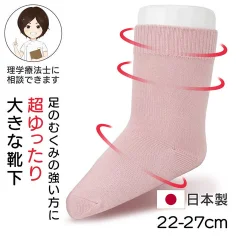
What if there's redness or rubbing?
After removing the brace, you may see redness or rubbing on the skin. Sometimes adjustments like these can help:
- Sweatiness → review the sock material
- Rubbing → check the sock thickness and fit
- Wrinkle marks → check the sock size and how they're put on
However, if redness, rubbing, pain or other problems continue, don't try to fix it with clothing alone — consult a doctor, rehabilitation professional or orthotist.
Don't just choose "a size up to be safe"
When a brace is used, people sometimes think:
- Can't we just go a size up for both trousers and socks?
But clothing that's too big brings its own problems.
Trousers that are too big can be trodden on or catch on a walking stick. Socks that are too big can wrinkle inside the brace and press on the skin.
Choose by shape, material, stretch and length — not size alone.
What the person used to wear matters too
Starting to use a brace doesn't mean everything has to change to "care clothing". During rehabilitation, occupational therapists may check things like:
- What they wore before going into hospital
- Favourite materials and textures
- Whether they like loose clothing
- Whether they can still wear clothes they used to love
In fact, people sometimes practise dressing in rehabilitation so that they can wear a favourite piece of clothing again.
Beyond the brace and physical function, we also want to value what the person has worn over the years.
Check the type of brace before choosing clothes
There are many kinds of ankle braces, so before buying clothes, check what kind is being used. If you're not sure, asking a physical or occupational therapist or an orthotist about the following makes choosing easier.
- The type of brace
- The height of the brace
- The steps for putting it on
- Shoe size with the brace on
- Anything to watch out for when choosing clothes
Summary | Trousers and socks each have different points to check
For someone with an ankle brace, check trousers for "easy to put the brace on, and safe to move in", and socks for "protects the skin and stays comfortable inside the brace".
- Trousers: hem width, stretch, length
- Socks: length, tightness, wrinkles, breathability, thickness
And the right clothing also depends on the type of brace and the person's physical condition.
Even with a brace, it matters to think together about ways to wear clothes that feel like "them", without strain.
If you're unsure about clothing, we can think it through together while hearing about the brace and the person's condition. Sending a photo of the brace and the measurement around its widest part on LINE makes it easier to choose trousers and socks.
Ask on LINE about trousers and socks that suit the brace