We recently attended the 27th Annual Meeting of the Japanese Society for Dementia Care.
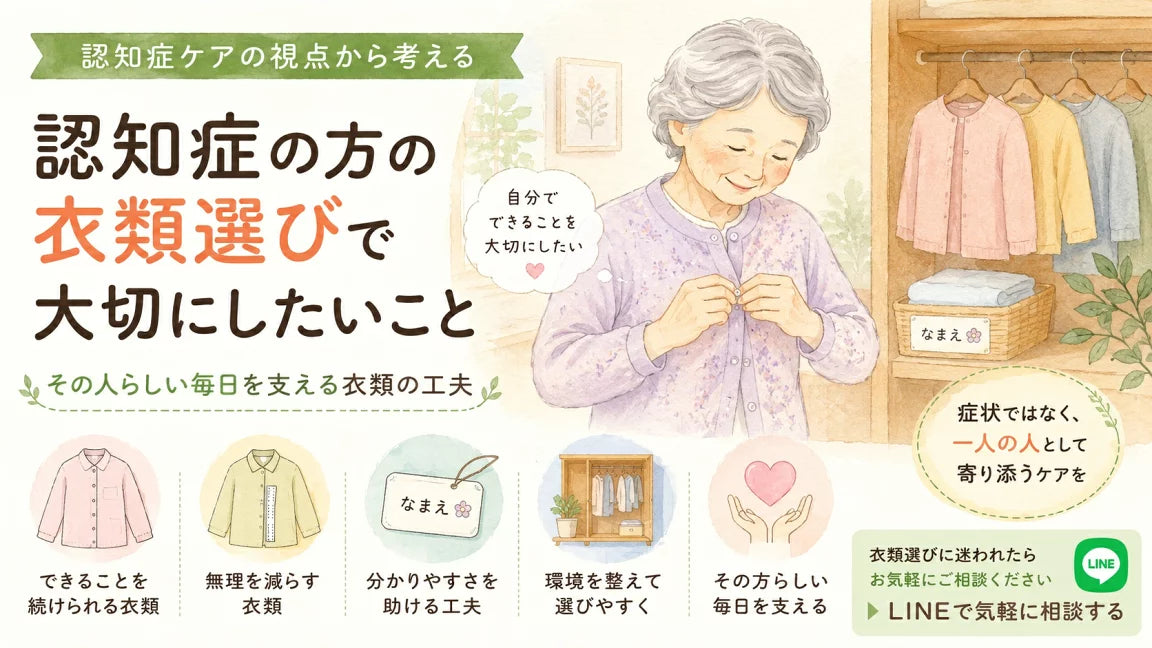
From what we learned there, this time we would like to share something about "changing clothes" for people with dementia.
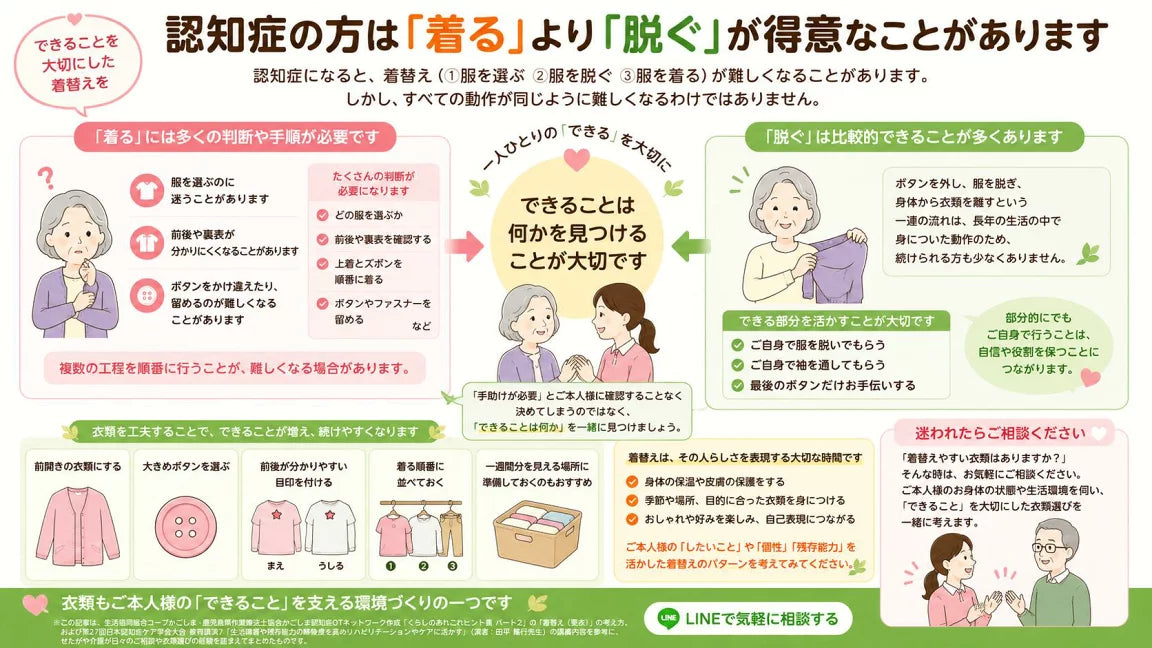
With dementia, changing clothes (1. choosing clothes, 2. taking clothes off, 3. putting clothes on) can become difficult.
However, not every part of changing becomes difficult in the same way.
In fact, some people are relatively more able to "take off" than to "put on."
"Putting on" requires many decisions
To put clothes on, many decisions and steps are needed, such as:
- Which clothes to choose
- Checking front and back, inside and out
- Putting on the top and the pants in order
- Fastening buttons and zippers
With dementia, carrying out several steps like these in order can become difficult.
As a result, things like the following can happen:
- The clothes are there, but I can't choose
- I can't tell front from back
- The buttons end up misaligned
"Taking off" is sometimes relatively manageable
On the other hand, some people are relatively good at the action of "taking off."
The sequence of undoing buttons, taking the garment off and moving it away from the body is a movement acquired over many years of daily life, and quite a few people can continue to do it.
Of course this does not apply to everyone, but before assuming that help is needed with everything, it is also important to check together how much the person can do.
Even when putting clothes on is difficult, there are cases where the person can do part of it, such as:
- Having them take their clothes off themselves
- Having them put their arms through the sleeves themselves
- Helping only with the last button
For a person with dementia, doing even part of the changing themselves helps maintain the confidence of "I did it myself" and the feeling of "I can still be useful," and may ease the anxiety of feeling they have lost their role.
Changing clothes is an important time for expressing who a person is
Changing clothes has the role of keeping the body warm and protecting the skin.
Beyond that, wearing clothing suited to the season, place and purpose, and enjoying dressing up, are also important ways of expressing who the person is.
Wearing brightly colored clothes can sometimes bring good changes, such as a brighter expression or mood.
Please think together about a way of changing that makes use of what the person "wants to do," their "individuality" and their "remaining abilities."
If you are unsure, please ask us
- Do you have clothing that is easy to change?
At times like that, please feel free to ask us.
At Setagaya Kaigo, we ask about the person's physical condition and living environment, and think together about clothing choices that value "what the person can do."
We would be glad if, with a little ingenuity in clothing, we can help the person go on spending each day in their own way.
* This article was put together by Setagaya Kaigo, drawing on our day-to-day consultations and experience in choosing clothing, with reference to the approach to "changing clothes" in 『くらしのあれこれヒント集 パート2』 (a collection of everyday living hints, Part 2) produced by Co-op Kagoshima and the Kagoshima Dementia OT Network of the Kagoshima Association of Occupational Therapists, and to Educational Lecture 7 at the 27th Annual Meeting of the Japanese Society for Dementia Care, 「生活障害や残存能力の解像度を高めリハビリテーションやケアに活かす」 (on understanding daily-life difficulties and remaining abilities in finer detail and applying this to rehabilitation and care; speaker: Dr. Takayuki Tabira).