Do you think it's fine because they are indoors?
Every summer we see news of heatstroke.
Among those cases, quite a few are older people who "got heatstroke at home."
As family, you may wonder:
- They're at home, so why would they get heatstroke?
In fact, it is said that as people get older, the way the body works changes little by little from when they were young, making heatstroke more likely.
With heatstroke, symptoms such as these can appear:
- Dizziness
- Unsteadiness
- Headache
- Nausea
- Clouded consciousness
When severe it can be life-threatening, so early prevention matters.
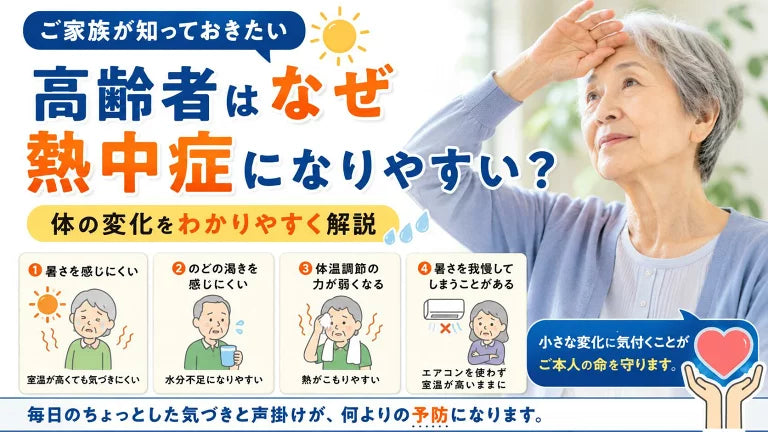
Reason 1: They may become less aware of heat
It is said that with age, the ability to sense heat gradually declines.
So even when the room is hot, some people think "it's not hot yet."
As a result, turning on the air conditioner is delayed, and the strain on the body can grow.
Reason 2: They become less aware of thirst
With age, people can become less aware of thirst.
So "I'll drink because I'm thirsty" can be too late.
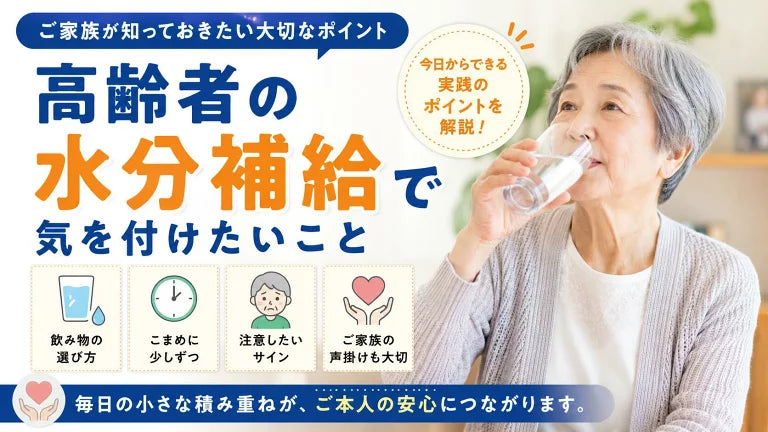
It is important to take fluids a little at a time, frequently, as an everyday habit.
Reason 3: The ability to regulate body temperature weakens
When it gets hot, our bodies keep temperature steady by sweating and releasing heat through the skin.
With age, these functions that regulate body temperature can gradually weaken.
So even when spending time in the same way as when younger, heat builds up in the body more easily, and heatstroke is said to become more likely.
Reason 4: They may put up with the heat
Some older people say:
- It's not hot yet.
- The air conditioner is a waste.
- I don't like getting too cold.
As a result, they may go without the air conditioner even when the room has become hot.
As family, try speaking in a way that respects the person's feelings and does not push, such as:
- Let's just turn it on a little.
- We'll turn it off once it's cool.
Everyday words like these also help prevent heatstroke.
There are small changes only family can notice
Older people quite often say "I'm fine."
But small changes such as these can be noticed precisely because family see the person every day:
- Less energy than usual
- No appetite
- Something seems different from usual
- Not drinking much
If you think "something's a little off," it is also important to check on them early and consult a medical institution as needed.
Heatstroke measures you can start today
There is no need to do anything special.
For example:
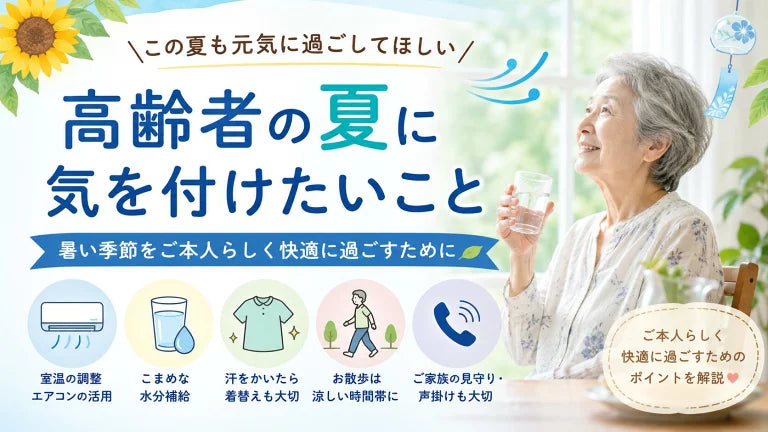
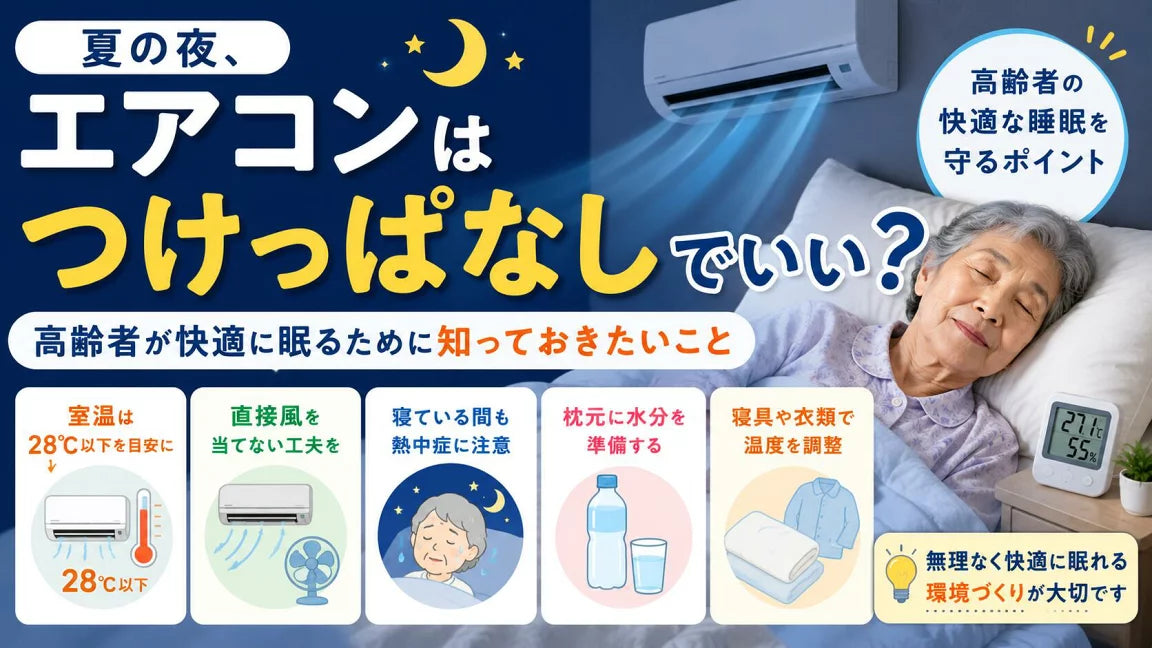
- Use the air conditioner without pushing through the heat
- Check the room temperature with a thermometer
- Take fluids a little at a time before feeling thirsty
- Change clothes after sweating
- Do not push to go out during the hot hours
Small daily habits like these help prevent heatstroke.
Clothing is one way of coping with heat too
Because people sweat easily in summer, it is reassuring to prepare clothing that is easy to change and comfortable even after sweating.
For those living in a facility, laundry and dryers are often used, so dryer-safe clothing is also useful.
In the season when sweating is frequent, it is reassuring to have 100% cotton undershirts ready as changes.
Undershirts we recommend as summer changes


If you are unsure about clothing, come to Setagaya Kaigo
At Setagaya Kaigo, we ask about things such as:
- The person's physical condition
- Life at the facility or at home
- Ease of changing
- How washing and the dryer are used
and suggest care clothing suited to that person.
Please feel free to ask us.
Feel free to ask us on LINESummary
As people get older, the way the body works changes little by little from when they were young:
- They become less aware of heat
- They become less aware of thirst
- The ability to regulate body temperature weakens
So even when the person thinks "I'm still fine," heatstroke can occur.
That is exactly why it matters to notice small daily changes, use the air conditioner without strain, and keep up frequent hydration.
The family's feeling of "I want them to stay well again this summer" leads to the best heatstroke prevention of all.
* This article is based on general thinking as of July 2026. If there are chronic conditions or concerns about physical condition, please consult a medical institution early.
References: Ministry of Health, Labour and Welfare, "Information and materials for heatstroke prevention"; Ministry of the Environment, "Heat Illness Prevention Information" (Japanese)