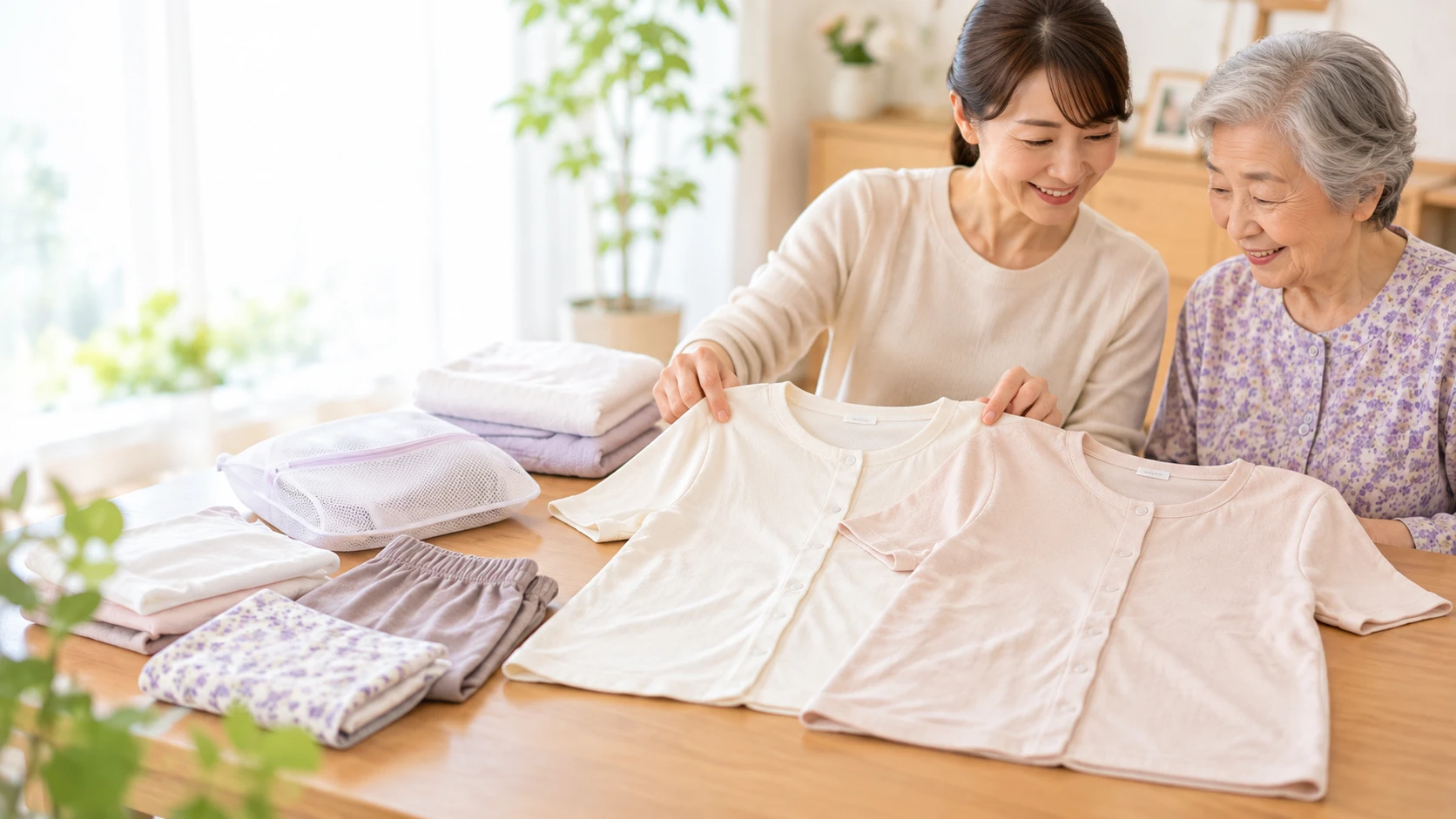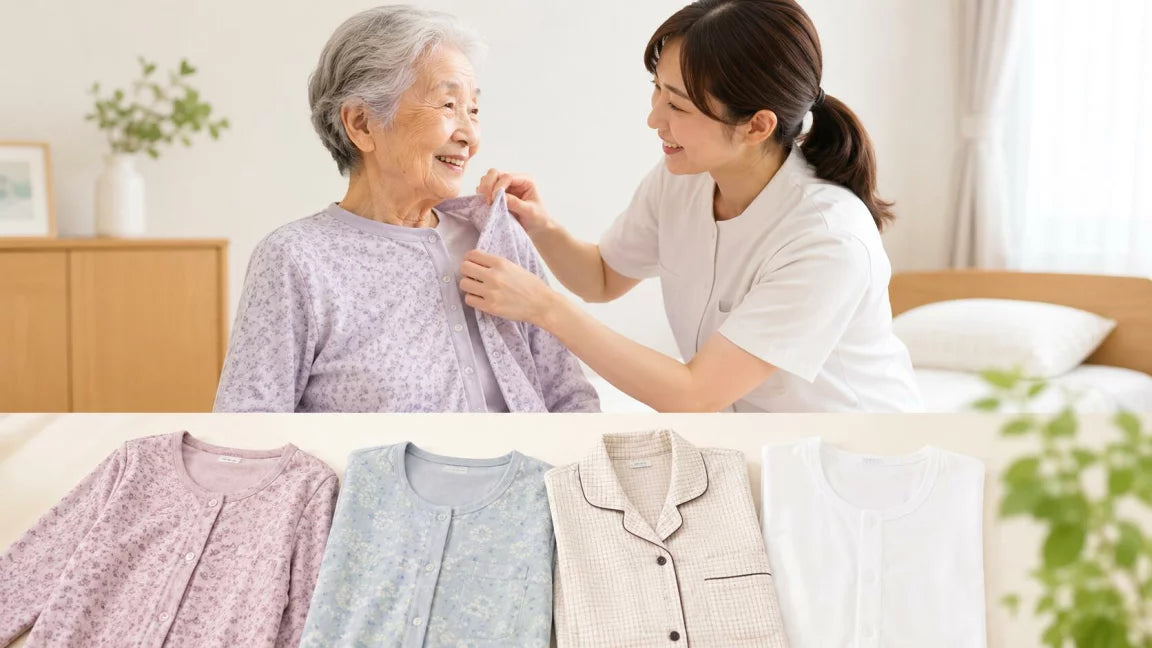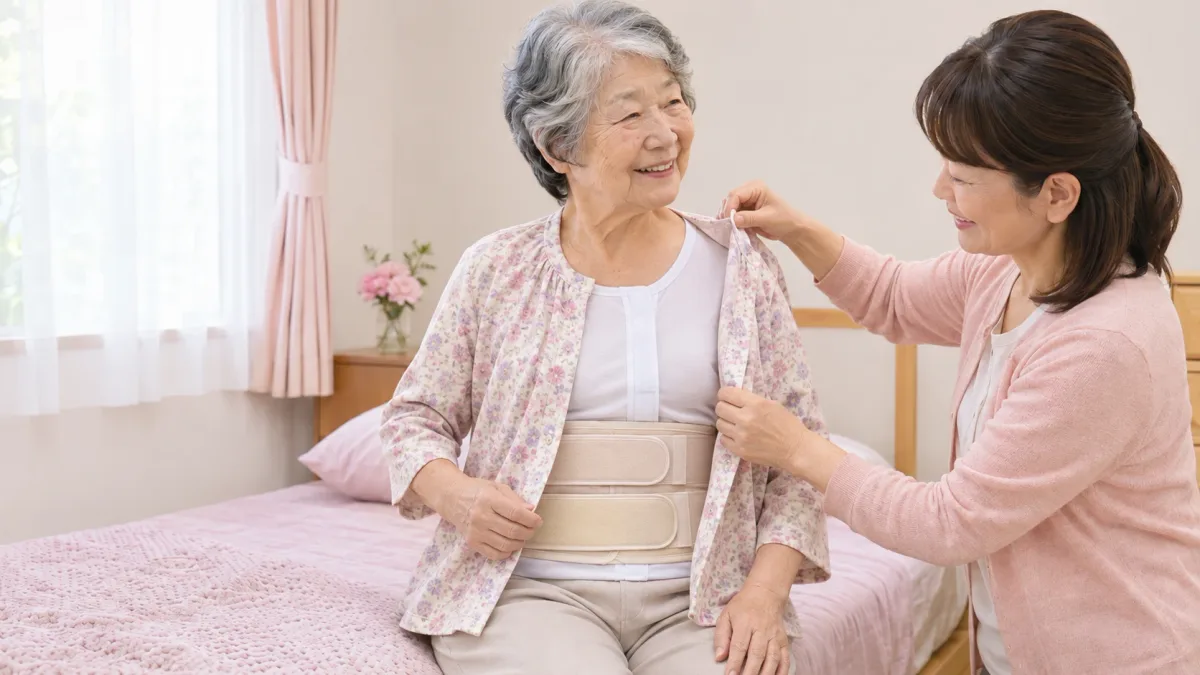
When a family member is admitted to hospital with a lumbar compression fracture and has to wear a corset, many families wonder:
- "What kind of underwear should we choose?"
- "Is front-opening underwear easier to change?"
- "If they're wearing a corset, should we buy a bigger size than usual?"
You may be asking the same questions.
At Setagaya Kaigo, too, families of people admitted to hospital with a lumbar compression fracture sometimes ask us how to choose front-opening underwear and what size to get.
In this column, with input from our store's occupational therapist, we look at how to choose underwear for someone who wears a corset after a lumbar compression fracture.
* Suitable clothing depends on where the fracture is and how severe it is, the type of corset, and the treatment plan. For how to actually wear it, please follow the instructions of the hospital's doctors, nurses and rehabilitation staff first.
The corset is usually worn over the underwear
There are many kinds of corsets for lumbar compression fractures, including plastic ones and ones with metal stays.
Generally, they are worn in this order:
Underwear → corset → hospital gown or clothes
That's the usual order.
So, as a rule, there's no need to think, "The corset is thick, so the underwear should be a bigger size too."
For the underwear worn under the corset, you can start from the size the person usually wears.
Start from the usual size
For example, if the person usually wears size M underwear and looks able to put it on and take it off without strain, it's fine to start with size M as usual.
However, if the pain from the compression fracture is severe and
- it's hard for them to sit up
- moving their arms or upper body hurts
- simply moving their body to change is a strain
then choosing one size up for a little extra room is also an option.
For example, someone who usually wears M might consider L.
That said, bigger isn't simply easier to change into.
Underwear that's too big can also be uncomfortable
If the underwear worn under the corset is too big, the extra fabric tends to bunch up into creases.
When the corset presses those creases against the body, they can rub the skin or feel uncomfortable.
So we recommend thinking of it like this:
- If they can change as usual, choose their usual size
- If pain or other problems make changing hard, choose a size with a little more room
That's the approach we suggest.
Rather than choosing a bigger size than needed, it's important to think about both ease of changing and how well the underwear fits the body.
With front-opening underwear, look at the fastenings too
This time, our occupational therapist particularly pointed out the fastenings on the front opening.
Front-opening underwear mainly uses:
- Buttons
- Snap buttons
- One-touch tape
and similar fastenings.
All of them let the front open wide to make changing easier, but when a corset is worn, a slightly different point of view is needed.
Buttons and snaps may be pressed in by the corset
Ordinary buttons and snap buttons have some thickness where they fasten.
When a corset is worn over them, those parts are pressed against the body, which in some cases may cause pain or discomfort.
Of course, this depends on the shape of the corset and where the fastenings sit, so it doesn't apply to everyone.
Still, if the corset covers a wide area around the waist and abdomen, it's worth paying attention to the thickness of the front opening.
Under a corset, one-touch tape is also an option
In this respect, one-touch tape underwear tends to keep the front opening thinner than buttons or snaps.
Changing is also simple:
Pull to open → line up the front and press to close
It goes on with these simple movements.
It's easy to use for people who find it hard to move because of compression fracture pain, and for those who are helped to change.
When choosing front-opening underwear for someone who wears a corset, we recommend checking
not only "Does the front open?" but also "What does the front fasten with?"
as well.
The front-opening underwear Setagaya Kaigo recommends
When people wearing a corset after a lumbar compression fracture ask us about front-opening underwear, we suggest this underwear as one option.
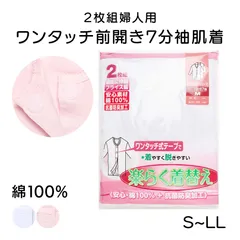 Women's 3/4-sleeve front-opening underwear, set of 2 (100% cotton; one-touch tape)Women's front-opening underwear in 100% cotton, with one-touch tape down the front. There's no need to do up buttons one by one, and the front opens wide for changing.
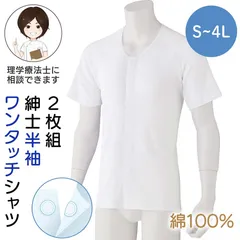 Men's short-sleeve one-touch shirt, set of 2 (100% cotton)Men's front-opening underwear in 100% cotton, with one-touch tape down the front. The seams are on the outside and there's no tag, so it's gentle on the skin.
Sizes are M, L and LL for women's, and S, M, L, LL, 3L and 4L for men's.
For the size, start from the size of underwear the person usually wears; if pain or other problems make changing hard, one size up is also an option.
If you're unsure about size, think about the person's condition too
When choosing care clothing, it can be hard to decide just by looking at a size chart.
Even among people who wear the same size, suitable clothing differs depending on
- whether they can change by themselves
- whether they are helped to change
- whether they are in pain
- whether they use a brace such as a corset
and so on.
Especially just after admission or a fracture, how easily the person can move may be very different from usual.
Rather than thinking "buying a bigger size is the safe choice," it's important to choose with the person's current condition and how they change in mind.
Summary
When choosing underwear for someone who wears a corset after a lumbar compression fracture, keep these points in mind:
- The corset is usually worn over the underwear
- Start from the usual size
- If pain makes changing hard, one size up is also an option
- If it's too big, creases in the fabric can cause discomfort
- With front-opening underwear, look at how thick the fastenings are
- Thin one-touch tape may be easier to use than buttons or snaps
Keeping these in mind makes choosing easier.
At Setagaya Kaigo, we help people choose clothing suited to their physical condition and living environment, drawing on the perspective of physical and occupational therapists.
- "I don't know which size to choose"
- "I don't know what clothes to prepare for a hospital stay or moving into a care facility"
If that sounds like you, please feel free to get in touch.
Consult via LINE