"What shall we talk about today?"
On the day you visit a parent or grandparent, do you ever find yourself thinking:
- What shall we talk about today?
In caregiving, help with meals and changing clothes matters, but conversation is just as important a time.
When talking about old memories, smiles come naturally, and you may hear an episode even the family is learning for the first time: "I never knew that happened!"
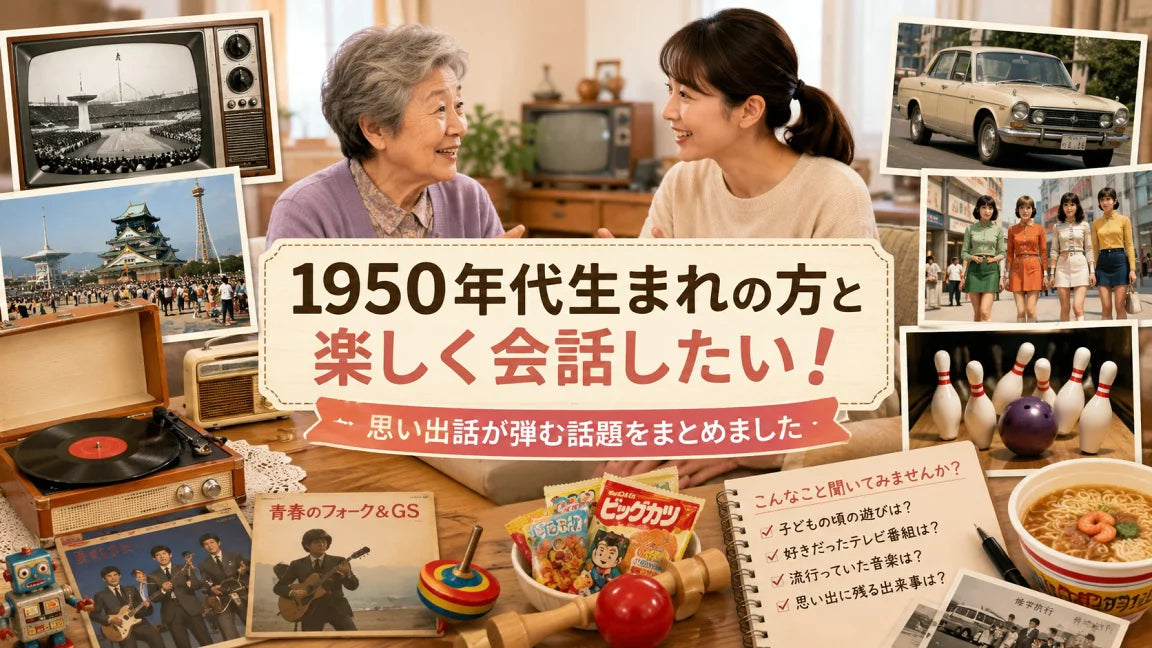
People born in the 1950s in Japan spent their youth in an era when the country developed greatly.
It was a time when televisions and cars spread into homes, and new culture was born one after another — music, fashion, leisure and more.
This time, we introduce things that happened around the years when people born in the 1950s were young.
Please use this as a way into conversation with your family.
You may come across an episode that stays in your heart: "I'm so glad I got to hear that!"
Childhood (late 1950s to the 1960s)
The days when television came into the home
Today everyone has their own smartphone, but back then, in some areas, simply having a television would bring the neighbors round.
Black-and-white television gave way to color broadcasts, and many people were captivated by the Tokyo Olympics.
Why not ask?
- Do you remember the day a television came to your home?
- What was your favorite TV program?
- What did the whole family watch together?
Playing outside was the norm
There were no game consoles yet.
When school was over, many children played outside until dark, at games such as:
- Menko (card-flipping)
- Beigoma (spinning tops)
- Kick the can
- Elastic jumping
- Tag
Why not ask?
- What did you play as a child?
- Who was your best friend?
- Was there a game you got scolded for?
The penny-sweet shop was the children's delight
Off to the dagashi-ya (penny-sweet shop), clutching a few tens of yen in pocket money.
Agonizing seriously over what to buy was part of the fun.
Why not ask?
- What sweets did you like?
- How much pocket money did you get?
- Did you go to the sweet shop every day?
A time when daily life was changing greatly
It was also a time when foods that could be eaten easily, such as instant noodles and retort-pouch foods, spread, and daily life changed greatly.
Why not ask things like these?
- What was the first car your family bought?
- Did you often eat instant noodles or retort-pouch foods?
- Is there a TV commercial you remember?
Youth (late 1960s to the 1970s)
Music was youth itself
In their youth, the following were all the rage:
- The Beatles
- "Group Sounds" bands
- Folk songs
Many must have memories of listening to the radio and collecting records.
Why not ask?
- Which singer did you like?
- What was the first record you bought?
- What did you sing at karaoke?
The excitement of the Osaka Expo
The 1970 Osaka Expo was a huge event that thrilled the whole of Japan.
Quite a few people actually visited.
Why not ask?
- Did you go to the Expo?
- Which exhibit made the biggest impression?
- What was the mood in Japan in those days?
First love and school trips
Memories of youth are often remembered surprisingly vividly.
Why not ask?
- What do you remember most from your school days?
- Where did you go on your school trip?
- Who was your favorite teacher at school?
When the miniskirt changed the streets
In 1967, when the British model Twiggy visited Japan, miniskirts became hugely popular.
The new style, so different from the fashion before it, became the dream of many young women, and the look of the streets changed greatly.
Many people still remember the fashions of their youth with deep feeling.
Why not ask things like these?
- What kind of clothes were in fashion when you were young?
- Was there an outfit that was your favorite?
- What did you take most care over when dressing up?
- What did you wear on dates?
The bowling alley was a popular place to play
From the late 1960s into the 1970s, a bowling boom swept the whole of Japan.
With the success of women professional bowlers such as Ritsuko Nakayama and Kayoko Suda, more and more people enjoyed bowling with friends or sweethearts.
It became a popular leisure activity enjoyed with family, friends and workmates.
Why not ask things like these?
- Did you go bowling often?
- Do you remember your best score?
- Do you have memories of going bowling on a date?
- How did you spend your days off in those days?
Starting out in working life
When rapid economic growth made Japan vigorous
Around the time they started work, Japan was growing richer and richer.
The Shinkansen ran, private cars multiplied, and towns changed greatly.
Why not ask?
- What was your first job?
- How much was your first salary?
- What did you buy with your first salary?
This is a topic that many people talk about with evident pleasure.
A wristwatch, clothes, a present for their parents — each person has their own memories.
Why not ask?
- Did you give someone a present from your first salary?
- What purchase made you happiest?
Marriage and raising children
Memories with family
Not only work, but marriage and raising children are also precious memories of a life.
Why not ask?
- What were the days like when the children were small?
- Where did you go on family trips?
- What event do you remember most?
There is no right answer in talking about the old days
With stories of the old days, even the answer "I don't remember" is fine.
What matters is to listen, with words like:
- So that's how it was.
- Tell me more.
You may hear an unexpected story, or discover a side of them that even the family did not know.
Why not ask just one thing today?
If you are unsure what to talk about, try starting with a question like this.
- What did you play when you were a child?
Surely, from that one question, the story of that person's own life will begin.
A few tips for conversation
- There is no need to look for the right answer.
- Just responding "So that's how it was" is enough.
- It is fine if there are things they don't remember.
- Even if the topic changes partway, just enjoy it as it is.
From Setagaya Kaigo
In caregiving, it matters not only to look after the body but also to value who the person is.
It is fine if the conversation does not last long.
Asking one question and getting one answer back is enough.
The very wish to talk can become a happy time for the family.
We would be glad if sharing memories becomes a chance for a few more smiles in your family.