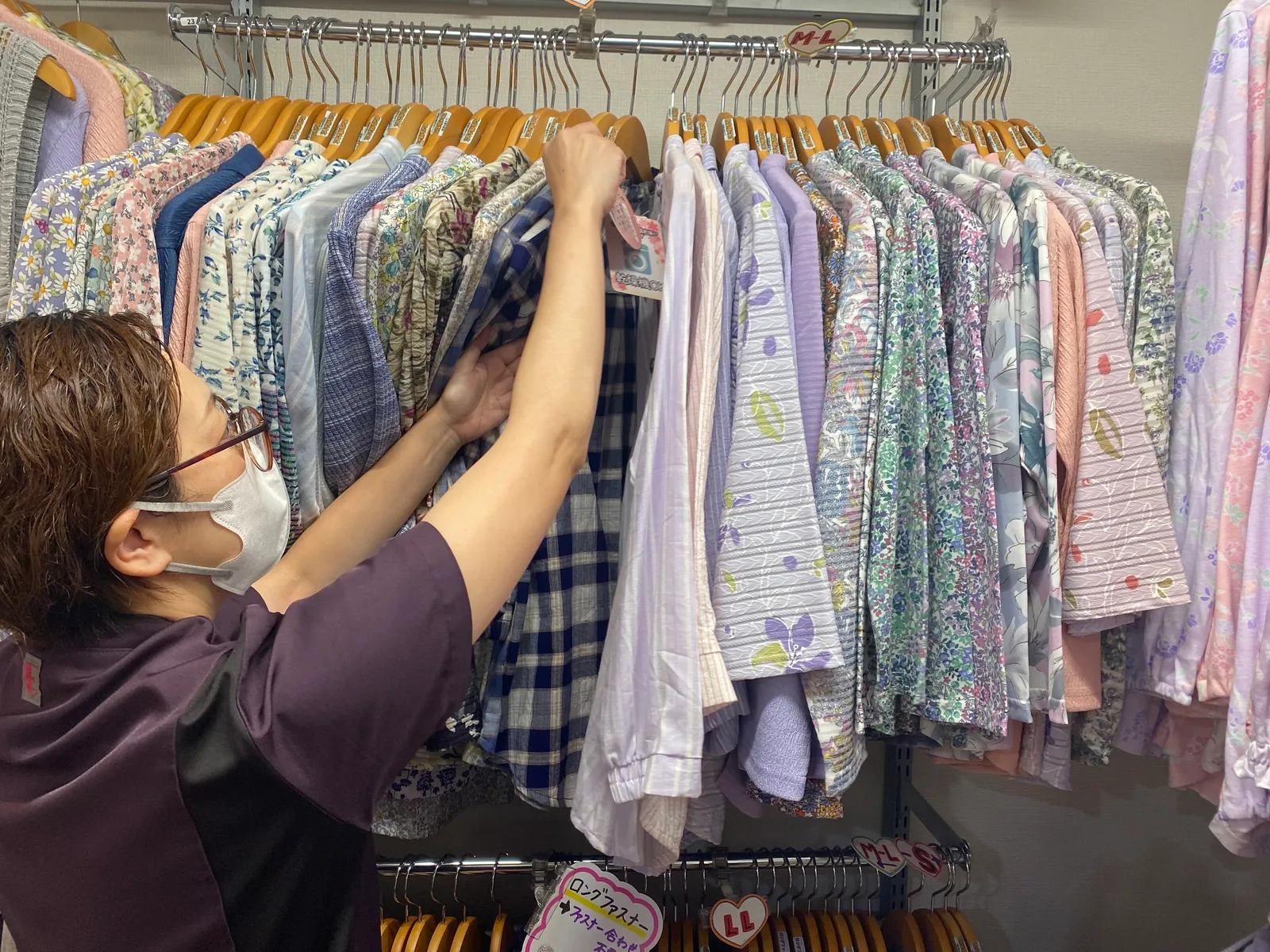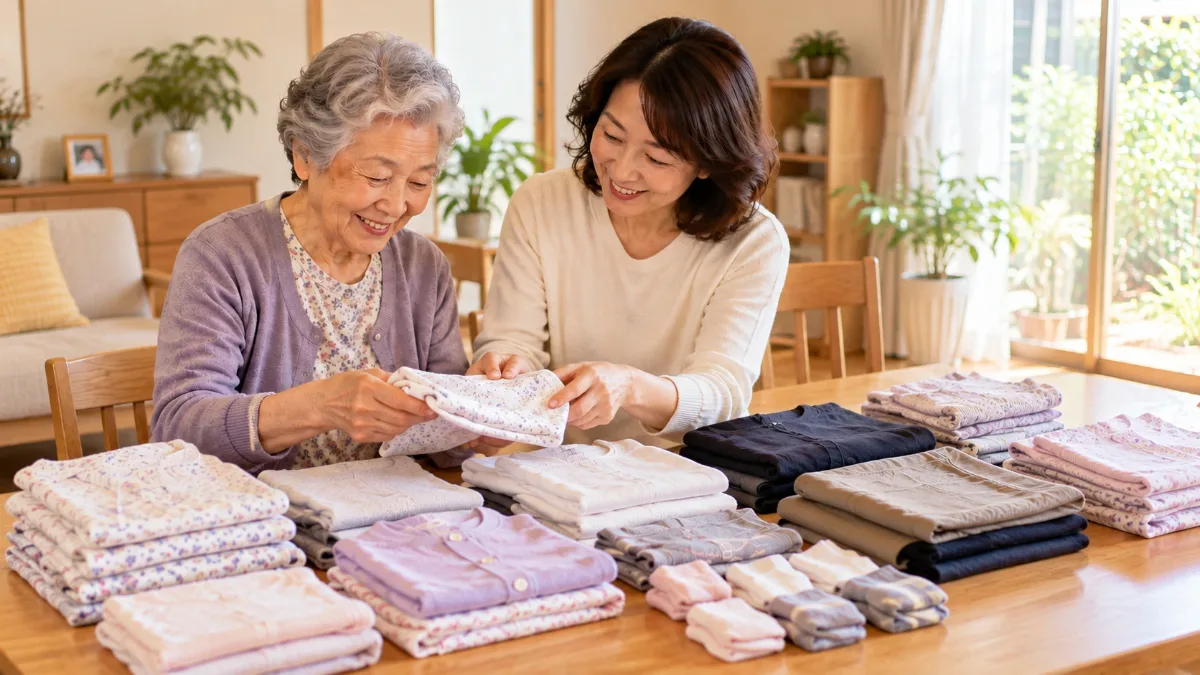
Once a move into a care facility is decided, there is so much to prepare that you may feel you need to rush out and buy a full set of clothes, too.
But there is no need to hurry and buy everything. Start by checking the facility's requirements and the clothes your parent already has.
- What should they wear in the facility?
- Can they use the clothes they've been wearing?
- Should we buy a full set of care clothing?
Many families have questions like these.
Moving into a facility doesn't mean every piece of clothing has to be replaced.
Some of the clothes they've been wearing may still be usable as they are. On the other hand, changes in their body may have made some old clothes hard to put on.
What matters is checking which current clothes can be used, replacing what no longer suits the person, and buying only what's missing. Here are four points to check before buying new clothes.
1. Check the facility's list of required clothing
First, check the clothing list the facility gives you. The types, numbers and conditions required differ between facilities — for example:
- How many everyday outfits are needed
- How many sets of underwear and socks are needed
- Whether pajamas are needed
- Whether a style is specified, such as front-opening
- Where and how names should be written
Even if the family prepares "what should be enough", the number required can differ by facility. Some facilities also specify front-opening clothing and so on.
Understanding what the facility needs is the first step to choosing clothes without waste.
2. Check how the facility does laundry
Next, check how laundry is done at the facility. Some facilities wash clothes together and use a tumble dryer. Clothes that were fine at home may shrink or get damaged in a dryer.
So to judge whether current clothes can be used, check the care labels too. On the other hand, some facilities don't use dryers, and some let you discuss other drying methods for certain items.
Not being dryer-safe doesn't necessarily mean it has to be replaced straight away.
Check the facility's laundry method, then decide whether current clothes can be used.
3. Go through the clothes the person already has
Once you know the facility's conditions, check what clothes the person has now. We recommend looking not only at everyday clothes but also inside chests of drawers, wardrobes and drawers.
For example, there may be several new undershirts or pairs of socks tucked at the back of a drawer. The person may have been keeping them in stock without the family knowing.
Buying without checking what they already have can leave you with more similar clothes than needed. First, sort out how many they have of each type:
- Everyday tops
- Trousers
- Underwear
- Pajamas
- Socks
Then compare this with the facility's list. But the number they own isn't necessarily the number usable in the facility — also check size, wear and the facility's laundry method.
Get the whole picture of what they own, then think about what's missing. That alone helps avoid buying more than needed.
4. Check whether their clothes suit their body now
This point is especially important. Clothes that used to be fine can become hard to change into as the person's body changes — for example:
- Arms are harder to raise
- Buttons have become hard to fasten
- They now dress with one hand
- Pulling trousers up and down takes longer
- They now use incontinence pants or nappies
- They spend more time in a wheelchair
- They now need help to change
In these cases, take another look at whether their clothes suit their body now.
Tops they can change into themselves
For example, someone whose arms are harder to raise may find pull-over T-shirts difficult. Switching to front-opening tops lets them change without lifting their arms high, which can make dressing themselves easier.
However, some people find buttons difficult, so not just any front-opening top will do. Check the type of fastener and how stretchy the fabric is, to suit how their hands and arms move.
Tops that are easier to change into
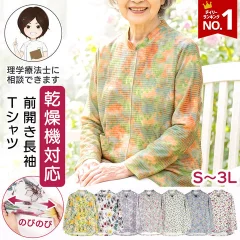 Front-opening Long-sleeve T-shirt (Seta CaRE; snap buttons; dryer-safe)A T-shirt with front snap buttons, so it goes on without pulling it over the head. Dryer-safe, with a printed label that doesn't scratch. Sizes S / M-L / LL-3L.
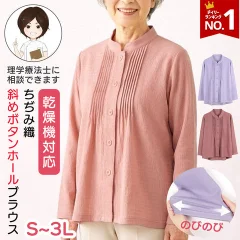 Chijimi-weave Pintuck Blouse (front-opening; dryer-safe)A front-opening blouse that goes on without pulling it over the head. The light crinkle-weave fabric doesn't cling to the skin, and the pintucks give it a neat look. Dryer-safe, sizes S / M-L / LL / 3L.
With trousers, pulling up and down at the toilet matters too
With trousers, the right size alone isn't always enough. For example, after starting to use incontinence pants, old trousers may feel tight around the waist and hips.
For people who pull trousers up and down with one hand, a stretchy waist and slippery fabric also matter. Choosing trousers designed for easy pulling up and down — like the Oshiri Surutto pants we carry — can make toileting easier.
Trousers designed to pull up and down easily
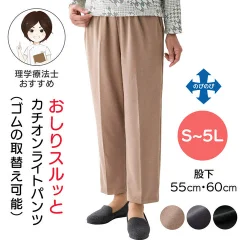 Oshiri Surutto Cationic Light Pants (women's; easy to pull up and down; fully elastic waist)A slippery lining at the waist stops it catching on the hips, so it pulls up easily even with one hand. Grips at the front keep it from slipping down when sitting on the toilet. Sizes S to 5L, 55cm/60cm inseam (women's).
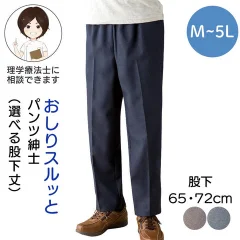 Oshiri Surutto Pants (men's; easy to pull up and less likely to slip down)Doesn't catch on the hips, so it pulls up easily even with weak hands or one hand. Grips at the front keep it from slipping down when sitting on the toilet. Sizes M to 5L, 65cm/72cm inseam (men's).
Depending on the person's condition, they may become able to do things themselves that used to need help.
Changing clothes can lead to a more comfortable daily life.
When help is needed, the choice of clothes changes too
The right clothes can differ depending on whether the person dresses themselves or family or staff help. For someone who often changes lying down, front-opening, stretchy clothes may be easier. Someone who can change standing up may be able to keep using their usual clothes.
Rather than "they need care, so care clothing", it's important to check which movements are difficult right now.
If you're not sure, ask the facility staff or a physical or occupational therapist.
If replacing, be clear about what's causing trouble
Once you've checked their clothes, sorting them like this makes things clearer.
- Meets the facility's conditions and wears fine
- Keep using it
- Still wearable but hard to change into
- Consider easier shapes or materials
- No longer fits
- Replace with a size that fits their body now
- Can't handle the facility's laundry method
- Check with the facility and replace if needed
- Not enough of them
- Buy only the shortfall
For example, their usual tops may be fine while only the trousers are better replaced with ones that pull up and down easily. Or the trousers may be fine while only the tops are better switched to front-opening because their arms are harder to raise.
Rather than replacing everything, be clear about what's causing trouble and choose only the clothes needed. We think that's the way to put together clothes that suit their life now.
Value their favourite clothes too
When preparing for a facility, it's easy to focus on function: easy to wash, easy to change, easy to manage. All of these matter. But clothing does more than that.
- A blouse in a favourite colour
- A cardigan worn for years
- A favourite outfit chosen together with family
Wearing clothes like these may help the person stay themselves in their new life.
Needing care doesn't mean giving up all the clothes they've loved.
While checking whether they suit life in the facility, we'd like to respect the person's preferences as much as possible.
Prepare what's needed for the move, then adjust to their life
Compare the facility's list with the clothes they have, and prepare what's needed for the move. For example, if the facility asks for five everyday outfits and three of their current ones are usable, you may only need two new ones.
Also, some needs only become clear once daily life in the facility begins. Prepare what the facility needs at move-in properly, but there's no need to bulk-buy clothes that aren't needed right away.
Another way is to add what's needed while watching how the person settles in.
If you're unsure about clothing, ask Setagaya Kaigo
- We don't know if their current clothes can be used
- We're looking for clothes they can change into themselves
- Pulling trousers up and down has become hard
- We need clothes that suit the facility's laundry
At times like these, please ask us. Setagaya Kaigo has physical and occupational therapists on staff, and we help choose clothing while hearing about the person's condition, what's difficult when changing, and their life in the facility.
Photos of the clothes they've been wearing and the facility's clothing list make the consultation more specific. On LINE, you can send photos as they are.
Let's think it through together — including whether their current clothes can still be used.
Ask on LINE about the clothes they already haveSummary | Check four things before replacing everything
Before buying new clothes for a facility move, check these four things.
- The facility's list of required clothing
- How the facility does laundry
- All the clothes the person already has
- Their current physical condition and what's difficult when changing
Keep and value the clothes that still work, and review only what no longer suits their body. New clothes can make dressing themselves easier or toileting more comfortable.
What matters isn't buying a lot, or getting by without buying. It's choosing just the clothes the person needs to be comfortable every day.
Setagaya Kaigo helps choose clothing that puts both the person and the family at ease.