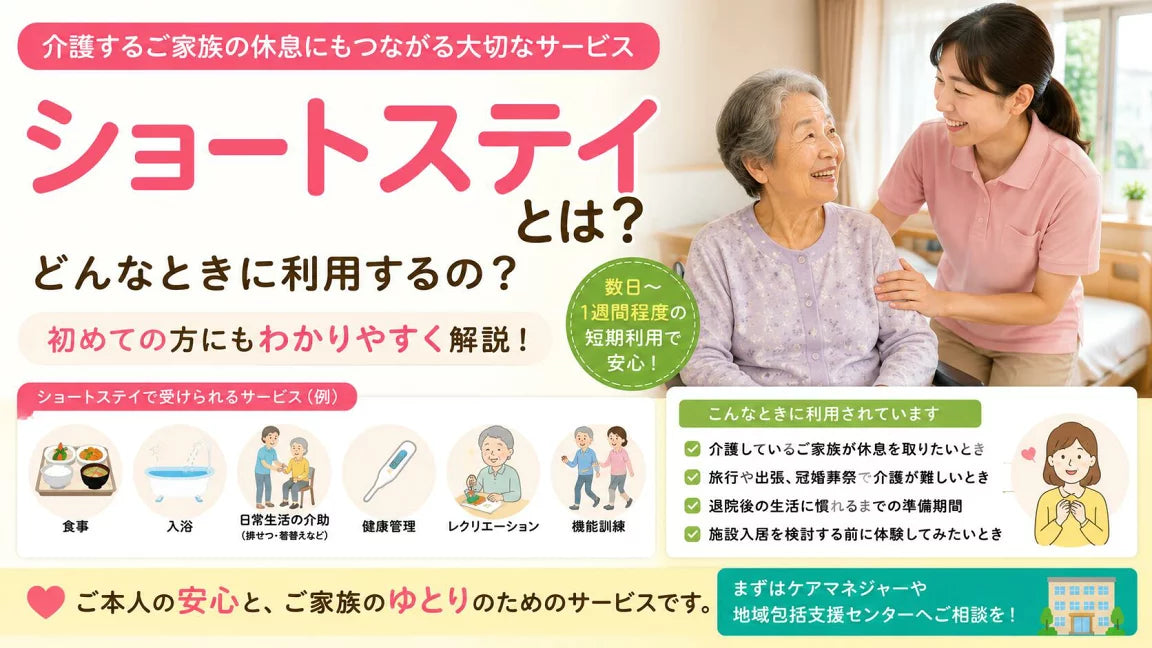
What is a short-term stay?
When you look into care, you may come across the term "short-term stay" (short stay).
- Is it different from moving into a facility?
- When is it used?
Many people have these questions.
A short-term stay is a long-term care insurance service in which the person stays at a care facility for a short period and receives meals, bathing, care and other services.
It is often used for a few days to about a week, and while the person spends time safely at the facility, the family can also take a break from caregiving.
What happens during a short-term stay?
It differs by facility, but generally the services include:
- Meals
- Bathing
- Help with daily life such as toileting
- Health management
- Recreation
- Functional training
While staying at the facility, the person can receive care suited to their physical condition.
When is a short-term stay used?
Short-term stays are used in many situations.
For example:
- When the family caring for the person wants to rest
- When the family has a trip or business travel
- When weddings, funerals and the like make caregiving difficult
- As a preparation period until the person gets used to life at home after leaving hospital
- When you want to try out life in a facility before considering moving in
Reducing the burden not only on the person but also on the family is an important role of short-term stays.
Who can use a short-term stay?
Short-term stays under long-term care insurance can be used by people certified as needing support or care.
The number of days that can be used depends on the care level and the care plan.
The details are decided in consultation with the person's care manager.
Certification for support or care under long-term care insurance is required. If the person has not yet been certified, the community general support center can guide you on how to apply.
How do you use a short-term stay?
If it is your first time, first consult the community general support center or the person's care manager.
The steps to using it are as follows.
- Consult the community general support center or a care manager
- Be introduced to a short-term stay that suits the person
- Visit and receive an explanation in advance
- Start using it
The atmosphere and services differ by facility, so it is reassuring to check in advance.
What should you bring to a short-term stay?
It differs by facility, but people generally prepare things like:
- Changes of clothes
- Underwear
- Towels
- Indoor shoes
- Regular medicines (if needed)
- Daily necessities
Some facilities ask you to write the person's name on all belongings and clothing.
See our free name printing serviceIt is reassuring to prepare a little extra clothing
Because a short-term stay involves staying overnight, you need to prepare several days' worth of:
- Changes of clothes
- Underwear
- Pyjamas
and so on.
Changes may be needed if clothes get dirty or sweaty, so it is reassuring to prepare one more set than the number of days planned.
Facilities also often use tumble dryers, so it is reassuring to prepare dryer-safe clothing.
Clothing that is easy to change and easy to wash is also easier to handle for the staff who help, not just for the person.
Clothing we recommend for a short-term stay
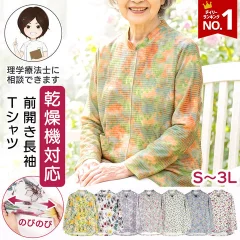
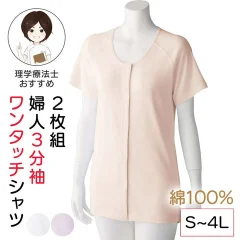
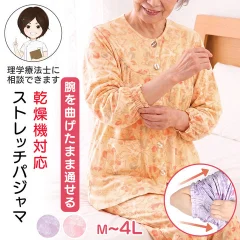
If you are unsure about clothing, ask Setagaya Kaigo
When a short-term stay has been arranged, we often receive questions like:
- What clothes should I prepare?
- I want to choose clothes that are easy to change into
We receive many such questions.
At Setagaya Kaigo, we listen to things such as:
- The person's physical condition
- The number of nights
- How easy it is to change
- Suitability for washing and tumble drying
and suggest care clothing that suits the person.
Please feel free to ask us.
Feel free to ask us on LINESummary
A short-term stay is a long-term care insurance service in which the person stays at a care facility for a short period and receives meals, bathing, care and other services.
It not only lets the person spend time with peace of mind, but also plays an important role in letting the family rest and making it easier to keep up caregiving.
If it is your first time, you don't have to search alone.
First consult the community general support center or the person's care manager, and think together about a short-term stay that suits the person.
*This article is based on the Japanese system as of July 2026. The system may be revised, so please check the details with your local municipality or community general support center.
References and sources: Ministry of Health, Labour and Welfare, "Overview of the long-term care insurance system"; Care Service Information Publication System, "What services are there? Short-term admission for daily life care (short stay)" (in Japanese)