About waterproof sheets, we sometimes hear:
- There are so many kinds that I don't know which one to choose
This is something people often tell us.
Waterproof sheets come in many types, differing in size, material and whether they are dryer-safe, so they are one of the care supplies people often find hard to choose at first.
Supervised by our store's occupational therapist, we explain how to choose a waterproof sheet that is easy to use.
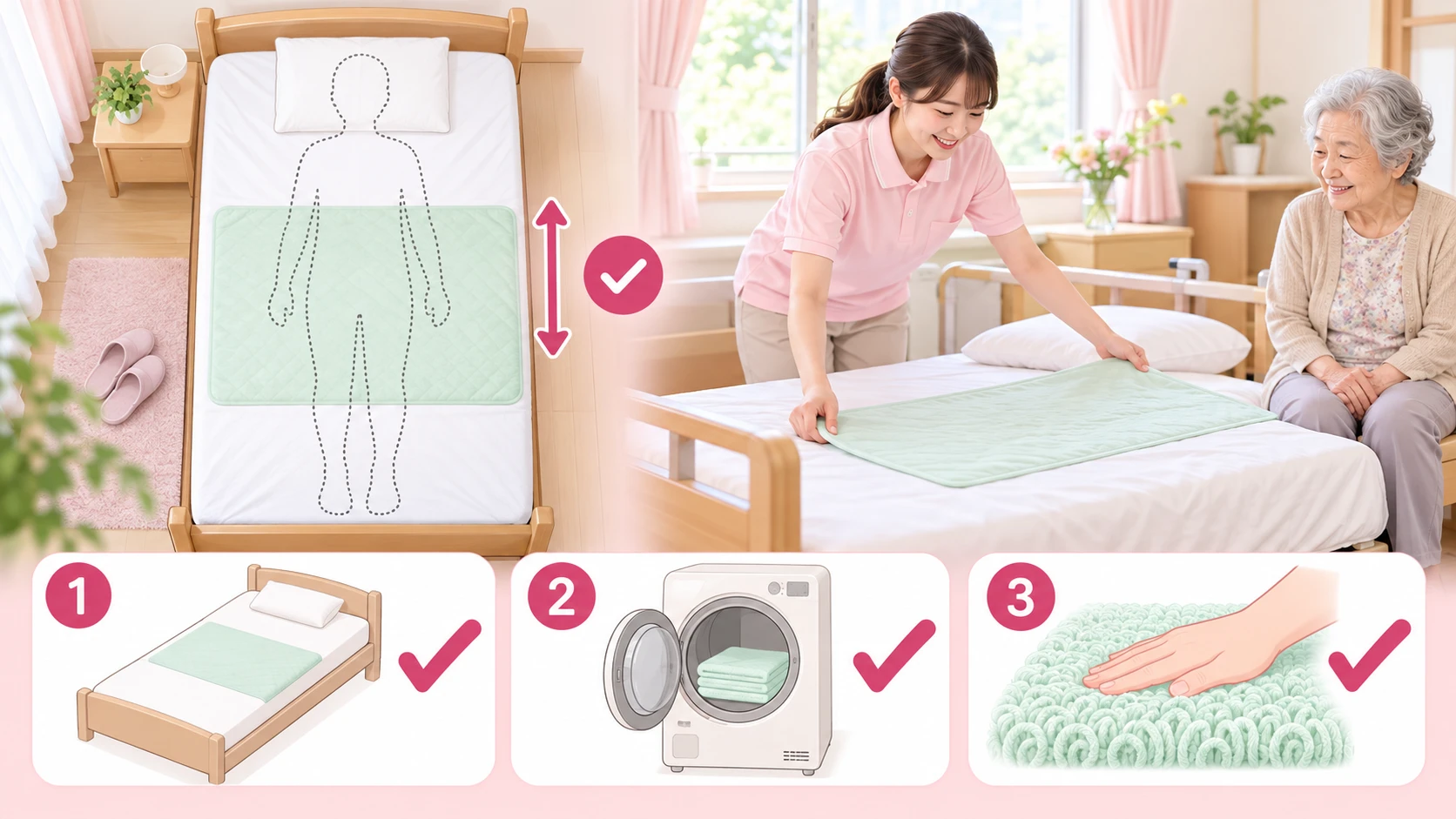
A partial waterproof sheet is easiest to use when it is "big enough to cover the area needed"
What is widely used in care homes is not the full type that covers the whole bed, but the partial waterproof sheet that covers the middle part of the body.
As a guide, a size that covers from about below the chest to about the knees when lying on the back is easy to use.
People with heavy incontinence may use the full type, but the full type comes with burdens such as:
- The laundry is bulky
- It tends to take a long time to dry
- Even if only part of it gets dirty, the whole sheet has to be washed
These add up day by day.
The partial type, which covers only the area needed, has the advantage of being easy to wash and change every day.
If it will be used in a facility, check whether it is "dryer-safe"
Care facilities for older people may use a tumble dryer after washing.
So when choosing a waterproof sheet, it is reassuring to check whether it is dryer-safe.
Even if you go to the trouble of preparing one, it will be hard to use if it does not suit the facility's laundry method.
Laundry methods differ by facility, so before buying, we recommend asking:
- Do you tumble dry waterproof sheets?
and confirming the answer.
For people who are unsteady turning over or getting up, the "surface material" matters too
With waterproof sheets, it is worth paying attention not only to waterproofing and size but also to the material of the surface that touches the body.
For people who can turn over and get up smoothly by themselves, there may be no need to worry much about slipperiness.
On the other hand, for people who:
- Can only just manage to turn over
- Take time to get up from the bed
- Are practicing getting up or doing rehabilitation
- Are still unsteady in the movements up to sitting
we recommend avoiding smooth knit fabrics that may be slippery and choosing pile (terry) fabric, which is relatively less slippery.
If the surface of the waterproof sheet is slippery, the body may slide or lose balance when getting up.
This could also lead to a fall from the bed, so for people who are unsteady getting up, care is needed in choosing the material too.
Three things to check when choosing a waterproof sheet
When choosing a waterproof sheet, start by checking these three points.
- How much of the bed needs to be covered
- Whether the facility uses a tumble dryer
- How well the person can turn over and get up
Is the incontinence heavy, or is partial waterproofing enough?
How will the facility wash and dry it?
And how does the person move their body on the bed?
Checking these points one by one makes it easier to choose a waterproof sheet that suits the person.
Choose one that suits the way the person lives
A large waterproof sheet that covers the whole bed is not necessarily easy to use for everyone.
What matters is to cover the area needed properly while also considering ease of washing and changing, whether it is dryer-safe, and how easily the person can move.
At Setagaya Kaigo, we receive questions not only about clothing but also from people who "don't know what to choose" for life in a facility.
If you are unsure about preparing for a move into a facility, please feel free to ask us at the store, by phone or on LINE.
We will think it through with you, listening to the person's physical condition and the living environment at the facility.
Feel free to ask us on LINESupervised by: Setagaya Kaigo occupational therapist