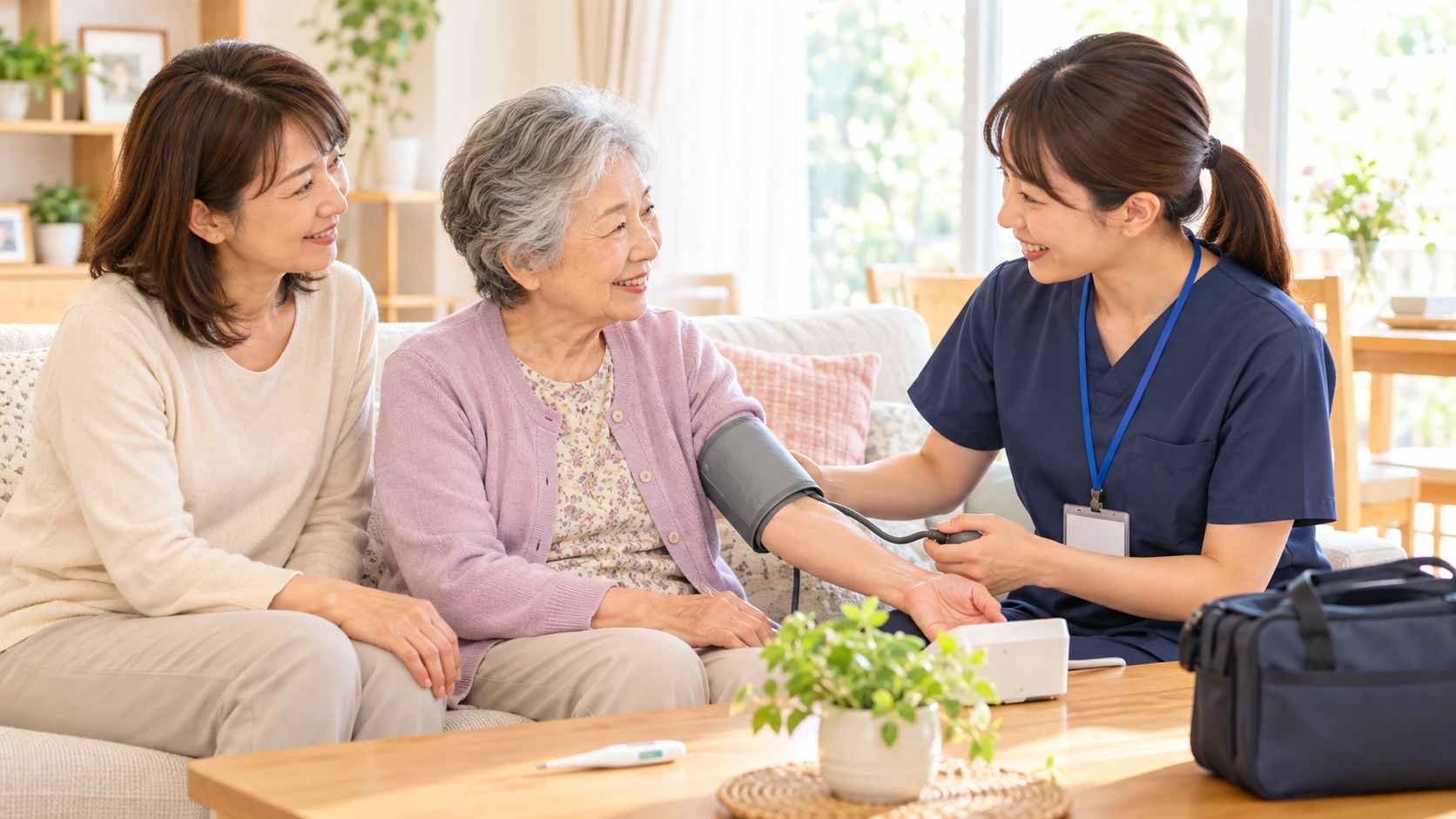
What is home-visit nursing?
When you look into care, you may come across the term "home-visit nursing".
But you may be wondering:
- How is it different from home-visit care?
- Does a nurse really come to the home?
Many people have these questions.
Home-visit nursing is a service in which nurses and other medical professionals visit the home to provide medical care and health management.
It helps people keep living with peace of mind in their familiar home, even with illness or disability.
What does home-visit nursing do?
With home-visit nursing, the person can receive support such as:
- Checking their state of health
- Measuring blood pressure, temperature and so on
- Managing medicines and giving advice about them
- Preventing and treating bedsores (pressure ulcers)
- Managing drips and medical equipment (when needed)
- Advice on care for the person and the family
The person can receive the nursing they need, according to their physical condition.
How is it different from home-visit care?
Home-visit care and home-visit nursing have similar names, but their roles are different.
Home-visit care
A home helper visits and provides services that support daily life, such as:
- Help with eating
- Help with bathing
- Help with changing clothes
- Cleaning and laundry
and so on.
Home-visit nursing
A nurse or other professional visits and provides:
- Health management
- Medical care
- Checks on the person's condition
and so on.
Which one is needed depends on the person's physical condition, and many people use both.
Who can use it?
Home-visit nursing can be used by people whose attending doctor judges it necessary.
For example, it is used by:
- People who still need medical care after leaving hospital
- People with a chronic illness who want regular health management
- People who want to continue their recovery at home
- Families who feel uneasy about caring on their own
and others.
How do you start using home-visit nursing?
First, consult the attending doctor, the person's care manager or the community general support center.
Generally, the steps are:
- Consult the attending doctor
- The doctor judges that home-visit nursing is needed
- Choose a home-visit nursing station
- Start using the service
That is the usual flow.
It may be used not only under long-term care insurance but also under health insurance. Which insurance is used depends on the person's physical condition and other factors.
For details, it is reassuring to check with the attending doctor or the home-visit nursing station.
A reassuring service for the family too
Home-visit nursing is a reassuring service not only for the person but also for the family.
You can ask about how to provide care and get advice about changes in the person's health.
- Can we keep caring for them at home?
Even when you feel uneasy like this, there is the reassurance of being able to ask a professional.
Clothing is also important in supporting recovery at home
Once people start using home-visit nursing, we sometimes hear:
- I want to prepare clothes that make check-ups and treatment easier
This is a question we receive.
Front-opening underwear and clothes that are easy to change are convenient not only for the person but also when the nurse checks their condition or gives treatment.
If you are unsure about clothing, ask Setagaya Kaigo
At Setagaya Kaigo, we listen to things such as:
- The person's physical condition
- How easy it is to change
- How easy it is for examinations and treatment
- Life at home
and suggest care clothing that suits the person.
Please feel free to ask us.
Front-opening clothing that makes check-ups and treatment easier
Summary
Home-visit nursing is a service in which nurses and other medical professionals visit the home to provide medical care and health management.
Whereas home-visit care supports daily life, home-visit nursing supports the person and the family from the medical side.
Which one is needed depends on the person's physical condition.
If you are unsure, don't decide alone. Consult the attending doctor, the person's care manager or the community general support center, and use the services that suit the person.
*This article is based on the Japanese system as of July 2026. The system may be revised, so please check the details with the attending doctor or your local municipality.
References and sources: Care Service Information Publication System, "What services are there? Home-visit nursing"; Ministry of Health, Labour and Welfare, "Overview of the long-term care insurance system" (in Japanese)


